3/29/2026
Case Studies
Every Bookkeeper Wastes 10 Hours a Month on Client Intake. Here Is the Fix.
Bookkeepers lose hundreds of hours a year chasing clients for documents. Here is how to automate your entire intake process and get that time back.
Whether you're onboarding new clients, collecting documents, or building intake forms, we'll help you get organized.
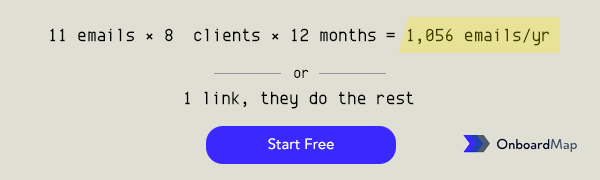
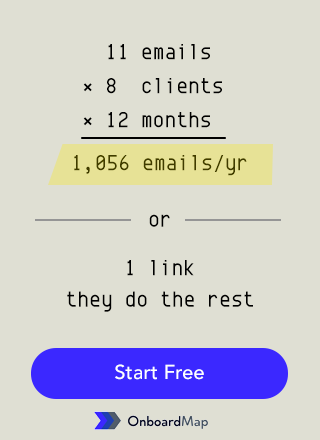
OnboardMap replaces email chaos with one link. Clients complete every step. You see progress instantly.

TLDR: Automate the repetitive parts of onboarding — reminders, document requests, intake forms, status updates — and keep the human touchpoints for kickoff calls, questions, and team handoffs. You save hours per client without making anyone feel like they are talking to a robot.
There are two types of service businesses. The ones where the founder personally sends every onboarding email, chases every document, and tracks every task in their head. And the ones that automated all of that six months ago and now spend their time on actual client work.
The first group is exhausted. The second group is scaling.
Automation is not about removing yourself from the process. It is about removing yourself from the parts that do not need you.
Not everything in onboarding should be automated. Some moments need a real human. The trick is knowing which is which.
Here is what a clean automated onboarding flow looks like for a service business:
That entire flow runs without you doing anything after step one. You set it up once and every new client goes through the same smooth process.
The biggest objection to automation is always the same: “Our clients expect a personal experience.”
They do. But here is what most people get wrong about what “personal” actually means.
Personal does not mean manual. A hand-typed email with three typos and no clear next steps is not more personal than a well-crafted automated message that uses the client’s name, references their specific project, and tells them exactly what to do next.
Personal means:
If you are a team of two or five, automation is not a luxury. It is survival.
Consider the math. If onboarding one client manually takes three hours of admin work — emails, reminders, document chasing, status tracking — and you onboard four clients a month, that is twelve hours. Every month. On work that adds zero value.
Automate that and you get twelve hours back. That is a full day and a half. Every month.
For practical tips on making this work with a lean team, check out our guide on client onboarding best practices for small teams.
A few things that trip people up:
You do not need a complex tech stack to automate onboarding. You need a tool that handles intake, document collection, and reminders — and connects them into a single workflow.
If you are still running onboarding through email and spreadsheets, even a basic onboarding platform will transform your process.
OnboardMap automates the tedious parts of onboarding — document requests, reminders, status tracking — while keeping the client experience clean and personal. Your clients get a branded portal. You get your time back.
Get early access to OnboardMap and build your first automated onboarding flow in minutes.
Send one link. Clients upload docs, fill intake forms, and complete every step — automatically tracked. No account required for your clients.
Austin Spaeth is the founder of OnboardMap, a client onboarding portal for service businesses. After years of watching agencies and consultancies lose time to scattered onboarding processes, he built OnboardMap to give every client a single link with everything they need to get started.
Client onboarding portal that replaces email chaos. Send one link. Clients upload everything, complete every step, and you see progress instantly.
Start For FreeFree plan includes 3 onboardings/mo.