TLDR: The difference between firms that scale smoothly and firms that drown in onboarding chaos comes down to one thing: systems. By batching intake, templatizing every workflow, and replacing email chains with a single client portal, service businesses can onboard 3-5x more clients per month with the same team — and actually start projects faster.
You just had your best month ever. Eight new clients signed. Your pipeline is full. Revenue is up.
And then Monday morning hits.
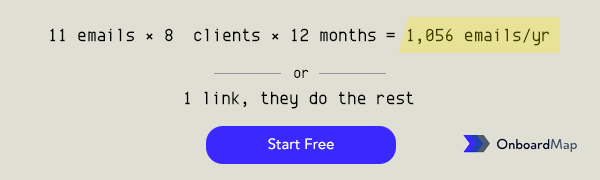
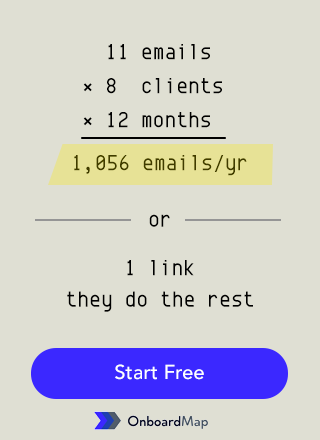
Eight welcome emails to write. Eight sets of documents to collect. Eight intake forms to chase. Eight different email threads to track. Eight clients all asking, “What do you need from me again?”
By Wednesday, you’ve lost track of who sent their W-9 and who hasn’t. By Friday, two clients think you’ve forgotten about them. By next Monday, a third client is already annoyed , and you haven’t even started the work yet.
Signing multiple clients is a sales win. Onboarding them all at once is an operations test. And most service businesses are failing it.
This isn’t a motivation problem. It’s a systems problem. And it has a very specific fix.
Why Onboarding Breaks at Scale
Onboarding one client at a time is manageable. You can keep everything in your head: what you’ve asked for, what’s arrived, what’s missing. Email works (barely) because you’re only tracking one thread.
But the moment you’re onboarding three, five, or ten clients simultaneously, everything that was “fine” falls apart.
| Clients in Parallel | What Breaks | How It Feels |
|---|
| 1-2 | Nothing (yet) | “Our process works great” |
| 3-5 | Email threads blur together; documents get misfiled; follow-ups slip | “It’s a busy week, we’ll catch up” |
| 6-10 | Tasks fall through cracks; clients wait days for responses; team scrambles | “We need to hire someone” |
| 10-20 | Clients get wrong documents; onboardings stall for weeks; churn begins | “We’re drowning” |
| 20+ | Complete breakdown without a system | “We can’t take on more clients” |
The instinct is to hire more people. But that’s not the bottleneck. The bottleneck is that you’re running a parallel process through a serial channel (email). More people running the same broken process just means more people drowning in the same inbox.
The Real Cost of Parallel Onboarding Chaos
Before we get to the fix, let’s quantify the damage. As we’ve detailed in the true cost of bad client onboarding, the per-client cost of onboarding friction is already significant. But when you’re onboarding multiple clients at once, these costs don’t just add up , they multiply.
| Cost Factor | Per Client | 5 Clients at Once | 10 Clients at Once |
|---|
| Follow-up time (emails, calls, re-sends) | 3-5 hrs | 15-25 hrs | 30-50 hrs |
| Context-switching overhead | 30 min | 5+ hrs | 12+ hrs |
| Errors (wrong docs, missed steps) | Rare | 1-2 per batch | 3-5 per batch |
| Average onboarding delay | 3-5 days | 7-14 days | 14-21+ days |
| Client satisfaction risk | Low | Medium | High |
The real killer is context-switching. Every time you jump from Client A’s email thread to Client B’s spreadsheet to Client C’s phone call, you lose focus. Research from the American Psychological Association shows context-switching can consume up to 40% of productive time. When you’re onboarding ten clients at once, you’re not doing ten things , you’re doing one thing badly, ten times.
The Onboarding Capacity Formula
Before you can fix the problem, you need to know your actual capacity. Here’s a simple formula:
Monthly Onboarding Capacity = Available Hours / Hours Per Client

Where:
  Available Hours = (Staff on onboarding) × (Hours/week on onboarding) × 4
  Hours Per Client = Time from welcome email to project kickoff
Let’s run the numbers for a typical small agency:
| Scenario | Staff | Hours/Week | Monthly Hours | Hours/Client | Monthly Capacity |
|---|
| Solo operator (email-based) | 1 | 10 hrs | 40 hrs | 5 hrs | 8 clients |
| Solo operator (with portal) | 1 | 10 hrs | 40 hrs | 1 hr | 40 clients |
| Small team (email-based) | 2 | 15 hrs | 60 hrs | 5 hrs | 12 clients |
| Small team (with portal) | 2 | 15 hrs | 60 hrs | 1 hr | 60 clients |
Read that again: the same team, same hours, 3-5x more capacity , just by changing the system.
This is why we built OnboardMap. Not to add more steps to your process, but to eliminate the manual overhead that’s capping your growth. When every client gets a single portal link with their checklist, uploads, and forms , and automated reminders handle the follow-ups , your “hours per client” drops from 5 to under 1.
See how it works →
The 5-Part System for Onboarding Multiple Clients Simultaneously
Here’s the framework that lets service businesses onboard 10, 20, or 50+ clients per month without adding headcount.
Part 1: Templatize Everything (Do the Work Once)
The single biggest leverage point is templates. Every minute you spend building a reusable template saves you hours every month.
Here’s what to templatize:
| Template | What It Covers | Time Saved Per Client |
|---|
| Welcome message | Portal link, expectations, timeline, what’s needed | 20-30 min |
| Intake questionnaire | Business info, goals, preferences, contacts | 15-20 min |
| Document request list | Every file you need, with labels and formats | 15-20 min |
| Task checklist | Every step for both your team and the client | 10-15 min |
| Reminder sequence | Automated nudges at day 2, 5, 7, 10 | 30-45 min |
| Kickoff agenda | Standard meeting format once onboarding is complete | 10-15 min |
Total time saved per client: 1.5-2.5 hours. Over 10 clients, that’s an entire work week recovered.
If you need a starting point, grab our free client onboarding template pack , it includes intake questionnaires, document checklists, and email sequences ready to customize.
For industry-specific templates:
The key insight: you should never be writing a welcome email from scratch. If every new client gets a slightly different version of the same thing, you don’t have a system , you have a habit.
Part 2: Batch Your Intake Windows
Most service businesses onboard clients as they come in. Client signs Monday, you start onboarding Monday. Another signs Wednesday, you start that one Wednesday. By the end of the month, you have clients at seven different stages of onboarding, and your attention is fractured across all of them.
The fix: batch your onboarding into weekly cohorts.
| Day | Activity | Why It Works |
|---|
| Monday | Send all new client portals for the week | One focused session, not scattered throughout the week |
| Tuesday-Thursday | Clients complete their portal tasks | You’re not involved , the portal and reminders handle it |
| Friday | Review all submissions, flag gaps, schedule kickoffs | Batch review is 3x faster than checking one-by-one |
This batching approach works because of the psychology we explored in why clients go silent during onboarding. Clients don’t complete tasks faster when you check in more often , they complete tasks faster when the process is clear and friction-free. Sending a portal link and letting automated reminders do the nudging is more effective than five personal follow-up emails.
Batching reduces context-switching by 60-80%. Instead of jumping between eight client email threads throughout the day, you handle all intake in one session and all reviews in another.
Part 3: Create a Single Source of Truth (Kill the Spreadsheet)
When you’re onboarding multiple clients, the most dangerous question is: “What’s the status of Client X’s onboarding?”
If answering that question requires opening email, checking a spreadsheet, looking in Google Drive, and asking a team member , your system is broken.
Every parallel onboarding needs a single place where you can see:
- Which clients are in onboarding right now
- What percentage of tasks each client has completed
- Which specific items are outstanding
- Who’s responsible for the next step (you or the client)
- How long each onboarding has been open
Here’s what tracking looks like at different levels of maturity:
| Method | Visibility | Effort to Maintain | Scales To |
|---|
| Memory | Your head only | Zero (until you forget) | 2-3 clients |
| Email labels/folders | You only (if you dig) | Moderate | 5 clients |
| Spreadsheet | Shared but manual | High (constant updates) | 10 clients |
| Project management tool | Shared and trackable | Medium (not client-facing) | 15 clients |
| Dedicated onboarding portal | Shared, real-time, client-facing | Low (auto-updates) | Unlimited |
The jump from spreadsheet to a dedicated portal isn’t incremental , it’s transformational. With OnboardMap, every client’s portal auto-updates as they complete tasks. You open one dashboard and see every active onboarding, every outstanding item, and every stalled client , in real time. No manual status updates. No asking the team “did Client X send their docs yet?”
For a deeper comparison, see OnboardMap vs. spreadsheets and why Asana and Monday aren’t built for client onboarding.
Part 4: Automate the Follow-Up Machine
When you’re onboarding one client, manually following up is fine. When you’re onboarding ten, it’s impossible. Here’s the math:
| Clients | Avg Follow-ups Per Client | Total Follow-ups/Month | Time at 10 min Each |
|---|
| 3 | 4 | 12 | 2 hours |
| 5 | 4 | 20 | 3.3 hours |
| 10 | 4 | 40 | 6.7 hours |
| 20 | 4 | 80 | 13.3 hours |
At 20 clients, you’re spending nearly two full days per month just writing “Hey, just checking in on that document” emails. That’s not onboarding , that’s babysitting.
Automated reminders aren’t a luxury when you’re scaling. They’re a requirement.
The ideal reminder sequence:
Day 1:  "Your onboarding portal is ready , here's your link"
Day 3:  "You've completed 2 of 8 tasks , here's what's next"
Day 5:  "3 items remaining before we can kick off your project"
Day 7:  "We're almost ready! Just 2 items left"
Day 10: Personal outreach (only if truly stalled)
Notice: 4 out of 5 touchpoints are automated. You only get personally involved when something is genuinely stuck. For the complete playbook on automation, see how to automate client onboarding.
This is one of the core features of OnboardMap , reminders fire automatically based on incomplete tasks. You set the cadence once, and every client gets nudged at exactly the right time. Your inbox stays clean. Your clients stay on track.
Try it free →
Part 5: Standardize Your Client-Facing Experience
Here’s what separates firms that scale from firms that struggle: every client gets the same professional experience, regardless of how many clients you’re juggling.
When you’re onboarding manually, quality degrades as volume increases:
| Volume | Manual Onboarding Quality | Systemized Onboarding Quality |
|---|
| 1-2 clients/month | High (personalized attention) | High (branded, structured) |
| 5-8 clients/month | Medium (some steps get rushed) | High (same template, same quality) |
| 10-15 clients/month | Low (things get missed) | High (automated, consistent) |
| 20+ clients/month | Critical (clients notice the chaos) | High (scales without degradation) |
The secret is that a well-designed system feels more personal than a manual one. A branded client portal with the client’s name, their project details, and a clear step-by-step checklist feels premium. A frantic email at 11pm asking “Did I already ask you for this?” does not.
Your clients don’t know (or care) whether you’re onboarding 1 client or 50. They care about their experience. When every client gets the same polished portal, the same clear instructions, and the same timely reminders , you can scale without anyone noticing.
The Parallel Onboarding Playbook: Week by Week
Here’s how to put the entire system together in a practical weekly rhythm.
Week 1: Setup (One Time)
Week 2+: Ongoing Rhythm
Monday: Launch
- Send portal links to all new clients from the previous week
- Review any stalled onboardings from prior weeks
- Time required: 30-60 minutes (regardless of client volume)
Wednesday: Midweek Check
- Glance at your dashboard for any red flags (0% completion after 3 days)
- No action needed for clients making progress , reminders handle it
- Time required: 10-15 minutes
Friday: Review & Advance
- Review all completed submissions
- Flag incomplete items (system sends automatic nudges)
- Schedule kickoff calls for clients at 100%
- Time required: 30-60 minutes
Total weekly time for 10+ parallel onboardings: 1.5-2.5 hours.
Compare that to the 10-15 hours you’d spend doing this through email. That’s an 80-85% reduction in time spent.
Industry-Specific Scaling Strategies
Different industries hit the parallel onboarding wall at different times and for different reasons.
Accounting Firms: Tax Season Surge
Tax season means onboarding 20-50+ clients in a 6-week window. There’s no “next month” , you either collect everything by the deadline or you don’t.
| Challenge | Solution |
|---|
| Dozens of clients all need the same documents at once | One template, duplicated for each client, with pre-labeled upload slots |
| Clients procrastinate until April | Automated reminders starting in January, with increasing urgency |
| Staff buried in email follow-ups | Portal-based collection eliminates 90% of follow-up emails |
| Can’t tell who’s sent what without checking every thread | Dashboard shows completion percentage for every client at a glance |
For the complete accounting onboarding system, see client onboarding for bookkeepers and accountants and our document collection checklist for accountants.
Marketing Agencies: Rolling New Business
Agencies typically onboard 3-8 new clients per month, year-round. The challenge isn’t seasonal volume , it’s maintaining quality while juggling active projects.
| Challenge | Solution |
|---|
| Brand assets trickle in over weeks, delaying campaigns | Specific upload slots (“Upload logo as PNG, 500x500 minimum”) reduce ambiguity |
| Creative teams waiting on credentials and access | Separate “access” section in the portal with platform-specific fields |
| Each client thinks they’re your only client | Automated progress updates make every client feel attended to |
| Account managers stretched across onboarding + active work | Systemized onboarding frees AMs to focus on strategy, not admin |
See client onboarding for marketing agencies for agency-specific workflows and templates.
MSPs: Security-First Onboarding at Scale
MSPs face a unique challenge: onboarding requires collecting sensitive credentials and access information. Doing this over email , especially for multiple clients at once , is a security risk.
| Challenge | Solution |
|---|
| Credentials sent via email (security risk) | Secure portal uploads with encryption, not email attachments |
| Device inventories take weeks to compile | Pre-formatted upload template clients can fill and submit in the portal |
| Compliance documentation scattered across channels | Single portal with audit trail showing who submitted what and when |
| Multiple technicians need visibility into different clients | Role-based dashboard access (Business plan) |
For MSP-specific guidance: client onboarding for MSPs and MSP onboarding questionnaire.
Consultants: Discovery-Heavy Intake
Consultants typically have fewer parallel onboardings but deeper intake requirements. The challenge is getting clients to complete lengthy discovery questionnaires when they’re already busy.
| Challenge | Solution |
|---|
| Long questionnaires go unanswered for weeks | Break into smaller sections; front-load easy questions for momentum |
| Scope and expectations unclear from day one | Structured intake form captures goals, KPIs, and boundaries before kickoff |
| Clients need to gather info from other stakeholders | Portal can be shared with multiple contacts on the client side |
| Consultant time is expensive , every admin hour is lost revenue | Automated intake recovers 3-5 hours per client |
More on this: client onboarding for consultants and how to build a client intake process.
The Dashboard View: What Parallel Onboarding Should Look Like
When you’re managing multiple onboardings, this is the view you need , not an inbox.
Example: 8 clients onboarding simultaneously
| Client | Industry | Portal Sent | Tasks Done | Status | Days Open | Next Action |
|---|
| Greenfield Marketing | Agency | Mar 1 | 7/8 (88%) | Almost done | 5 | Review final upload |
| Dr. Chen’s Practice | Medical | Mar 1 | 6/8 (75%) | On track | 5 | Waiting on insurance docs |
| Apex Consulting | Consulting | Mar 1 | 8/8 (100%) | Complete | 4 | Schedule kickoff |
| Harbor Accounting | Accounting | Mar 3 | 3/8 (38%) | Needs nudge | 3 | Auto-reminder sent today |
| BlueShift IT | MSP | Mar 3 | 5/8 (63%) | On track | 3 | Waiting on device inventory |
| Sterling Law Group | Legal | Mar 4 | 1/8 (13%) | At risk | 2 | Reminder scheduled for tomorrow |
| Peak Performance Gym | Fitness | Mar 5 | 4/8 (50%) | On track | 1 | Progressing normally |
| ClearView Financial | Financial | Mar 5 | 2/8 (25%) | New | 1 | Just started |
In 10 seconds, you know exactly where every client stands. No digging through email. No checking spreadsheets. No asking your team.
This is what OnboardMap’s dashboard gives you. Every active onboarding. Every outstanding task. Every stalled client. One screen. Updated in real time as clients complete their portal tasks.
Get this view for your business →
Common Mistakes When Scaling Onboarding
Mistake 1: Hiring Before Systemizing
The reflex when onboarding gets overwhelming is to hire. But adding people to a broken process just spreads the chaos across more inboxes.
Fix: Systemize first, then hire if you still need to. Most firms find that a proper onboarding system eliminates the need for the hire entirely.
Mistake 2: Over-Customizing Every Onboarding
“But every client is different!” Yes , and 80% of what you collect is the same. The intake form, document list, and follow-up cadence are nearly identical. Customize the 20% that matters (project-specific questions, industry-specific docs) and templatize the rest.
Mistake 3: Treating Onboarding as a “Nice to Have”
Onboarding is the first real experience your client has with your business. As we explore in client retention starts with onboarding, the first 30 days predict the entire relationship. When you’re onboarding multiple clients at once and the quality drops, you’re not just losing efficiency , you’re losing clients.
Mistake 4: Using Project Management Tools for Client-Facing Onboarding
Asana, Monday, Notion , they’re great for internal work. But asking clients to log into your project management tool to complete onboarding tasks creates friction and confusion. Clients don’t want to learn your PM tool. They want a simple link with clear steps. See why project management tools aren’t built for client onboarding.
Mistake 5: No Visibility Into What’s Stuck
When you’re onboarding one client, you know what’s missing. When you’re onboarding ten, you need a system that surfaces stalled onboardings automatically. If you have to manually check each client’s status, you’ve already lost. You need a tool that shows you , at a glance , which clients are on track and which need attention.
How to Get Started This Week
You don’t need to overhaul everything at once. Here’s the minimum viable system you can set up today:
Step 1: Pick one template. Start with the universal onboarding checklist and customize it for your service.
Step 2: Move document collection out of email. Whether you use OnboardMap, a shared folder, or any portal tool , stop collecting documents via email attachments. It’s the single biggest bottleneck. See how to collect documents from clients securely.
Step 3: Set up automated reminders. Even a basic email sequence is better than manual follow-ups. For templates, see our follow-up email templates for clients not responding.
Step 4: Batch your launches. Pick one day per week to send all new client onboarding portals. This alone will reduce your context-switching by half.
Step 5: Build your dashboard. You need one screen that shows every active onboarding and its status. If you’re tracking this in a spreadsheet today, OnboardMap can replace it with a real-time dashboard that updates itself.
The Bottom Line
Onboarding multiple clients at once isn’t a luxury problem , it’s the defining operational challenge for every growing service business. The firms that solve it grow smoothly. The firms that don’t cap out, burn out, or start losing the clients they worked so hard to win.
The difference isn’t more people or more hours. It’s a system.
One template. One portal link per client. Automated reminders. A single dashboard for visibility. That’s the entire stack.
OnboardMap was built for exactly this. Send each client a branded portal link with their checklist, document uploads, and intake forms. Reminders go out automatically. Your dashboard updates in real time. Whether you’re onboarding 3 clients this month or 30, the process is the same , and the quality never drops.
Your next batch of clients is coming. Be ready.
Get early access to OnboardMap →