TLDR: You do not need a dedicated operations team to onboard clients like a pro. Standardize your process into a repeatable template, automate your follow-ups, collect everything through a single link, and keep the client experience dead simple. These practices let small teams onboard faster and more professionally than firms three times their size.
When you are a team of three, onboarding a new client is both exciting and terrifying. Exciting because new revenue. Terrifying because you are already stretched thin and now you have to manage a multi-step intake process on top of everything else.
The good news: small teams can onboard clients just as well as large firms. Sometimes better. You just need the right practices in place.
Here are the onboarding best practices that actually work when you do not have a dedicated operations team.
1. Standardize Your Process Before You Automate It
The biggest mistake small teams make is jumping straight to automation before they have a clear process. Automating chaos just gives you faster chaos.
Start by writing down every step of your current onboarding. Be specific:
- What happens after the contract is signed?
- What information do you collect from the client?
- What documents do you need before work starts?
- Who on your team handles what?
- How long does each step typically take?
Once you have this documented, look for steps you repeat with every single client. Those are your candidates for standardization. Build templates for your welcome message, your intake questions, and your document checklist. Use a client intake form template as a starting point, or follow our complete guide to building a client onboarding workflow from scratch if you need a step-by-step approach.
The goal is to make onboarding identical for every client, with room for customization where it matters.
2. Send One Link, Not Ten Emails
This is the single biggest upgrade most small teams can make.
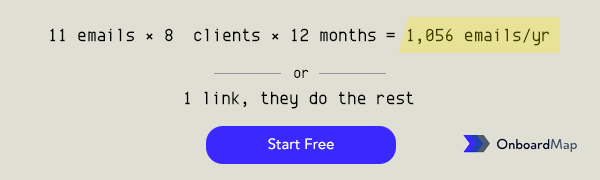
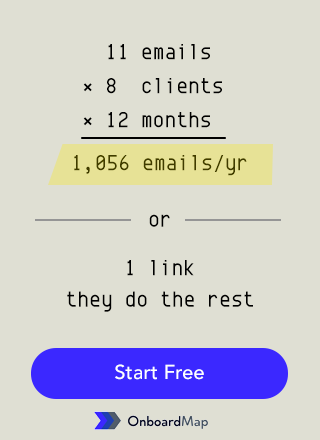
Instead of dripping out instructions across multiple emails over multiple days, give your client one link that contains everything they need. One page. One checklist. All their forms, document uploads, and instructions in one place.
Clients do not want to dig through their inbox to find the email you sent last Tuesday with the form link. They want to know: what do I need to do, and where do I do it?
One link solves that.
3. Collect Documents Upfront, Not Later
Too many small teams start work before they have everything they need. Then they spend weeks chasing missing documents while trying to deliver on the project at the same time.
Do not start work until onboarding is complete. That means defining a clear “onboarding complete” milestone — the specific set of forms and documents that must be in hand before the project kicks off.
For an accounting firm, that might be:
- Signed engagement letter
- Prior year tax returns
- QuickBooks access credentials
- W-9 form
- Photo ID
For a marketing agency:
- Brand guidelines document
- Logo files (vector format)
- Social media account credentials
- Target audience brief
- Signed scope of work
Define your list, collect it in one place, and do not move forward until it is done. Your future self will thank you.
4. Automate Your Follow-Ups
On a small team, you do not have time to manually chase every client for every missing item. This is where automation pays for itself immediately.
Set up automated reminders that trigger when items are incomplete. A typical cadence:
- Day 2: Gentle reminder that items are still pending.
- Day 5: Slightly more direct reminder with a link back to their portal.
- Day 9: Final reminder noting that the project timeline may be affected.
Three reminders. Automatic. No effort on your part.
If a client still has not responded after three automated reminders, then you pick up the phone. But in most cases, the automated nudges do the job. For more on this, read our full guide on how to automate client onboarding while keeping it personal.
5. Create a Repeatable Checklist for Your Team
Your clients are not the only ones who need clarity. Your team does too.
Build an internal checklist that runs alongside the client-facing one. It should cover:
- Who sends the welcome message (or is it automated?)
- Who reviews the intake form once it is submitted
- Who checks uploaded documents for completeness and accuracy
- Who schedules the kickoff call
- Who marks the client as “onboarding complete”
When roles are clear, nothing falls through the cracks. This matters even more on a small team where one dropped ball has a bigger impact.
6. Set Expectations on Day One
Clients get anxious during onboarding because they do not know what is happening or what is expected of them. Fix this by setting expectations immediately.
Your welcome message should include:
- What you need from them (the full list, not a drip)
- When you need it by (a specific date, not “as soon as possible”)
- What happens next after they complete everything
- How long the onboarding process typically takes
- Who to contact if they have questions
When clients know the plan, they follow it. When they do not, they stall.
7. Keep the Client Experience Simple
This is worth repeating: your onboarding experience should be effortless for the client.
That means:
- No account creation or app downloads
- No confusing dashboards with features they do not need
- No jargon or internal terminology
- Clear labels on every form field and upload request
- Mobile-friendly everything
If your 60-year-old client who barely uses email can complete your onboarding without calling you for help, you have nailed it.
8. Use a Checklist as Your Onboarding Backbone
For a full breakdown of what to include in your onboarding checklist, see our guide on building a client onboarding checklist for service businesses. It covers the specific items you should track, how to organize them, and how to adapt them to different service types.
At a minimum, your checklist should cover:
- Welcome and introductions
- Intake form completion
- Document collection
- Account or system access
- Internal team setup
- Kickoff meeting
- Onboarding complete confirmation
9. Review and Improve After Every Cohort
Every quarter, look back at your last batch of onboarded clients and ask:
- Where did clients get stuck?
- What items took the longest to collect?
- Which questions on the intake form caused confusion?
- Did any clients express frustration with the process?
Small teams have an advantage here. You are close to your clients. You hear their feedback directly. Use it.
Putting It All Together
You do not need a ten-person operations team to run great onboarding. You need a standardized process, automated follow-ups, and a simple client experience. That is it.
OnboardMap was built for small service teams that want professional onboarding without the overhead. Branded portals, intake forms, document collection, and automated reminders — all designed to work when your team is lean and your time is limited.
Explore the templates and see how quickly you can set up a repeatable onboarding process.