TLDR: The best client onboarding automation examples are not strategies, they are specific trigger-action rules you can copy. Send the welcome and portal link the moment a client signs. Send the intake form when onboarding starts. Request named documents with a checklist. Remind clients automatically when something is overdue. Escalate nudges for silent clients, schedule the kickoff once intake is done, alert yourself when a client stalls, confirm each completed step, keep progress visible, flag wrong files on upload, hand a packet to delivery at the end, and request feedback while it is fresh. Build the first four this week and you reclaim most of the time onboarding eats.
Search “client onboarding automation” and you get a wall of advice that never tells you what to actually build. Automate more. Keep the human touch. Map your process. All fine, and all useless the moment you sit down to set something up. This article is the opposite: twelve client onboarding automation examples written as concrete trigger-action rules, each one a “when this happens, do that” you can copy into whatever tool you use. A trigger is an event (a client signs, a form is submitted, a document goes overdue). An action is what fires in response (send, request, schedule, alert). String the right triggers to the right actions and a new client moves from signature to fully set up with the system doing the mechanical work and you showing up only where a human matters.
What Counts as a Client Onboarding Automation?
Every automation below has the same anatomy. Something happens, a condition is checked, an action fires, and it is timed so the client gets it at the right moment instead of whenever you remember. Keep this shape in mind as you read, because it is also how you will sanity-check any automation you build: name the trigger, name the action, and decide the timing.
If you want the strategic layer under these examples, what to automate in client onboarding covers which steps belong to a machine and which stay human. This piece is the build list that follows from that decision.
The 12 Client Onboarding Automation Examples
Here is the swipe file. The first four are the ones to set up before anything else, because they cover the tasks that eat the most time and get dropped the most often. The rest are worth adding once those run on their own.
1. Welcome and portal link on signature
Trigger: the client signs or pays. Action: send a warm welcome message with their single portal link. Timing: within minutes, automatically.
A new client is never more engaged than in the hour after they commit. Making them wait a day for a manual welcome email wastes that energy and plants the first seed of doubt. This is the easiest high-value automation to set up and the one clients notice most. The golden hour after a client signs is exactly the window humans are worst at hitting reliably, which makes it perfect for automation.
2. Intake form on onboarding start
Trigger: onboarding begins. Action: deliver the intake form or questionnaire inside the portal. Timing: immediately, as the first task.
A structured form collects cleaner information than any email back-and-forth, and it works while you sleep. Sending it automatically means the client always has a clear first action waiting, instead of a vague “I will send over some questions soon” that sits in your drafts.
3. Named document requests with a checklist
Trigger: the client reaches the document step. Action: request each specific file by name, as a checklist. Timing: alongside or just after intake.
“Send me your documents” produces the wrong files, half the files, or nothing. A checklist that names each item (prior-year return, voided check, logo in vector format) tells the client exactly what done looks like. This is the single most tedious part of onboarding to run by hand, and automating the request also keeps sensitive files out of email, where they should never live. See how to collect documents from clients securely for the security side.
4. Automatic reminder when an item is overdue
Trigger: a form or document passes its due time. Action: send a friendly reminder naming exactly what is missing. Timing: on a set delay, such as three days.
“Chase the client who went quiet” should never be a task on your list. A behavior-triggered reminder does the follow-up you would otherwise forget, and because it is automated it never feels awkward or naggy the way a manual “just circling back” does. This is covered in depth in how to automate client onboarding reminders.
5. Escalating nudges for a silent client
Trigger: the client takes no action after the first reminder. Action: a short sequence of nudges that changes tone. Timing: day 2, day 5, day 9, then a personal note from you.
One reminder is easy to miss. A gentle escalation (a nudge, then a “still need these to start,” then a personal message) respects that people are busy without letting the engagement stall silently. The handoff to a personal note at the end is deliberate: automation handles the first rounds so your personal time is spent only on the clients who genuinely need it.
6. Kickoff scheduling once intake is complete
Trigger: the intake form is submitted. Action: reveal a scheduling link for the kickoff call. Timing: the moment intake is done.
Gating the kickoff behind completed intake does two things: it makes the call more productive (you walk in already knowing their situation) and it gives the client a concrete reason to finish the form. The four-email dance to find a meeting time disappears.
7. Stall alert to you or your team
Trigger: no client activity for a set number of days. Action: notify you or an owner internally. Timing: after the client has gone quiet past your threshold.
Most clients who drift away in onboarding do it silently. An internal alert when someone stalls turns a quiet churn risk into a prompt to reach out while the relationship is still warm. This is the automation that catches the clients your reminders did not.
8. Confirmation and next step on completion
Trigger: the client finishes a step. Action: confirm it and surface the next action. Timing: instantly.
A small “got it, here is what is next” closes the loop and keeps momentum. Without it, clients finish a task and wonder if it worked, which is where second-guessing and support emails come from. Each confirmation also gives the client a tiny sense of progress, which is what keeps people moving through a sequence.
9. Always-visible progress
Trigger: any change in status. Action: update a live progress view the client can see anytime. Timing: continuous.
“Where are we?” is one of the most common and least necessary emails in onboarding. A live status view answers it before it is asked, for the client and for you. It also quietly sets expectations, because the client can see what is theirs to do versus what is waiting on you.
10. Flag wrong or missing files on upload
Trigger: the client uploads a document. Action: check it against what was requested and flag anything wrong or missing. Timing: at upload.
Clients send the wrong documents constantly, and discovering it a week later restarts the whole request. Catching it at the moment of upload (wrong file type, missing page, uploaded to the wrong slot) saves a full round-trip and keeps onboarding moving.
11. Handoff packet to delivery at completion
Trigger: onboarding is marked complete. Action: assemble the intake answers, documents, and context into a packet for your delivery team. Timing: at completion.
The transition from onboarding to delivery is where context gets dropped and clients have to repeat themselves. Automating the handoff means the person doing the work starts with everything the client already provided, no re-asking.
12. Feedback request at the end
Trigger: onboarding completes. Action: send a short feedback request. Timing: while the experience is still fresh.
Asking “how was getting started?” right after onboarding gives you honest signal while the details are fresh, and it tells the client you care how the experience felt. It is also your early-warning system for the friction points that quietly cost you future clients.
How Much Time Does This Actually Save?
The reason to automate is not tidiness, it is hours. The mechanical admin behind onboarding (the welcome emails, the document chasing, the reminders, the status updates, the handoffs) runs roughly 60 to 120 minutes per client for most service businesses, and automation removes about three quarters of it. Move the sliders to your own numbers.
Onboarding Automation Savings Estimator
Assumes automation removes about 75 percent of the manual admin per client.
Even the conservative end of that range adds up fast. At 8 clients a month and 90 minutes of admin each, you are looking at more than 100 hours a year, time that goes straight back into billable work and the client conversations that actually build the relationship. The ROI of onboarding automation breaks the economics down further if you want the dollar figures.
Manual vs Automated, Side by Side
Here is what each core workflow looks like with and without automation. The pattern is always the same: manual depends on your memory and availability, automated depends on nothing.
Onboarding step
Done manually
As an automation
Welcome and portal access
Sent when you remember, varies by day
Fires within minutes of signature, every time
Intake information
A back-and-forth email thread
Structured form, delivered on start
Document collection
You chase, they forget, files land in email
Named checklist, tracked, stored securely
Overdue follow-up
Depends on your memory
Triggered on a set delay, worded for you
Silent client
Noticed days or weeks late, if at all
Escalating nudges, then a stall alert to you
Progress updates
Client emails to ask “where are we?”
Live status visible anytime
Handoff to delivery
Context re-explained, things dropped
Packet assembled automatically at completion
Which Automations to Build First
You do not need all twelve running this week. Build them in the order their payoff lands.
Welcome and portal link on signature. Highest visibility, lowest effort. Start here.
Intake form on start. Gives every client a clear first action.
Named document checklist. Kills the single biggest time sink.
Automatic overdue reminders. Removes “chase the client” from your list for good.
Kickoff scheduling on intake complete and live progress, once the first four are solid.
Stall alerts, upload checks, completion handoff, and feedback, as you scale and the gaps show.
If your onboarding still feels custom and resistant to this, it is usually not as bespoke as it looks. Most of what feels one-off is simply a template you never built. The checklist is not a process distinction is worth reading if you are stuck there.
Do You Need Software for This?
You can assemble these twelve automations from separate tools: a form builder, a scheduler, a file-sharing service, an email sequencer, and a spreadsheet to track it all. It works, but it creates the exact problem you were trying to solve. The client ends up with five logins, five emails, and five chances to get lost, which is how “automated” onboarding ends up feeling fragmented and cold.
This is where purpose-built software is the natural answer. With a tool like OnboardMap, you describe your onboarding in a sentence and it builds the whole flow: the checklist, the intake forms, and the document requests. Every client gets one magic link, no login, so all twelve workflows above run behind a single clean experience. The welcome fires on signature, the reminders escalate on their own, uploaded files are read and checked, progress stays live, and you get real-time visibility into exactly where each client is stuck. In other words, the whole swipe file comes pre-wired instead of hand-stitched. If you have been meaning to fix onboarding but dreading the tool-wrangling, you can set up an automated onboarding flow in a few minutes. For the step-by-step version of turning this into a repeatable system, see how to automate client onboarding.
Frequently Asked Questions
What are the best client onboarding automations to set up first?
Start with four: send the welcome message and portal link automatically the moment a client signs, send the intake form the instant onboarding starts, request specific named documents with a checklist, and fire a reminder on its own when any item is overdue. These cover the tasks that eat the most time and get forgotten most often. Everything else is worth adding once those four run reliably.
What is a client onboarding automation, exactly?
It is a trigger-action rule that runs without you. A trigger is an event (a client signs, a form is submitted, a document goes overdue). An action is what happens in response (send an email, request a file, schedule a call, alert your team). Good onboarding automation chains these rules so a client moves from signature to fully set up with the system handling every mechanical step.
Can you automate client onboarding without it feeling impersonal?
Yes, and done right it feels more considerate. Clients read friction as impersonal: five emails, a missing link, a reminder that never came. One portal link, a clear checklist, and reminders that arrive on time feel like someone is paying attention. Automate the logistics so you have energy for the human moments, the kickoff conversation and the first real win.
How much time does onboarding automation actually save?
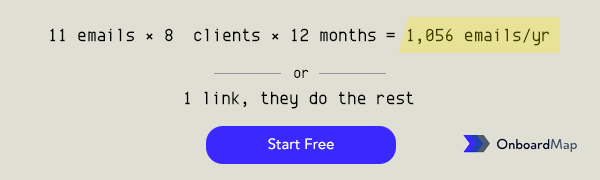
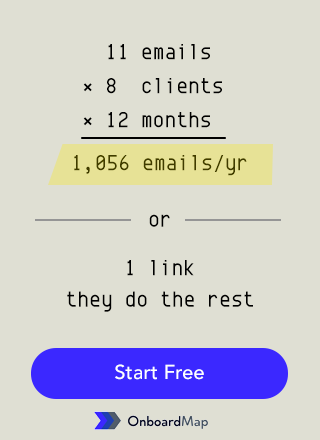
For most service businesses the mechanical admin runs 60 to 120 minutes per client, and automating it removes roughly three quarters of that. At 8 new clients a month and 90 minutes each, that is about 9 hours a month, or more than 100 hours a year.
Do I need special software to automate client onboarding?
You can stitch automations together from separate tools, but that patchwork creates the fragmented, multi-login experience you are trying to avoid. Purpose-built client onboarding software runs all twelve workflows behind a single portal and magic link, so the automation is reliable and the client still sees one clean experience.
Client onboarding automation stops being abstract the moment you write it as trigger and action. Pick the first four from this list, build them this week, and you will feel the difference in the first client who onboards without a single manual email from you. The rest you can add as you grow. The goal is not to remove yourself from onboarding, it is to clear the mechanical work off your plate so your time goes where it actually counts: the conversations that turn a new client into a long one.
Ready to fix your onboarding?
Send one link. Clients upload docs, fill intake forms, and complete every step — automatically tracked. No account required for your clients.
Austin Spaeth is the founder of OnboardMap, a client onboarding portal for service businesses. After years of watching agencies and consultancies lose time to scattered onboarding processes, he built OnboardMap to give every client a single link with everything they need to get started.
OnboardMap
Onboard clients in one sentence. Describe what you need and OnboardMap builds the whole onboarding, checklist, forms, and document requests, then sends one link and tracks every step for you.