Client onboarding automation ROI is the time and money you recover by handing the repetitive parts of onboarding, sending intake forms, chasing documents, reminding quiet clients, and updating status, to software instead of doing them by hand. Most service businesses spend two to four unbilled hours of admin on every new client, and almost none of it requires judgment. Automate roughly 70% of that work and the recovered time is worth far more than the software costs, usually several times over, before you even count the faster time to first value and the churn you avoid.
The reason this cost stays invisible is that it never arrives as one bill. It shows up as fifteen minutes here drafting a form, ten minutes there re-sending a document request, five minutes answering the same question you answered last week, a half hour reconstructing who has done what. Scattered across days and clients, it feels like “just part of the job.” Added up across a year, it is one of the largest hidden line items in the business. This article puts a number on it, shows you which tasks actually pay to automate, and gives you a calculator to run on your own figures.
What Does Manual Client Onboarding Actually Cost?
Start with the honest inventory. For a single new client, a manual onboarding process typically includes some version of this:
Drafting or copy-pasting a welcome email and an intake form or questionnaire.
Requesting documents, then following up once, twice, sometimes three times when they do not arrive.
Answering the same handful of questions clients always ask, one email at a time.
Collecting files from wherever the client sent them (email, text, a random link) and filing them somewhere findable.
Updating a spreadsheet or project board so you remember who is at which step.
Sending “just checking in” messages to clients who have gone quiet.
Manually kicking off the next stage once the client finally completes theirs.
None of that is the work the client is paying for. It is the overhead of getting to the work. Time it honestly for your next three clients and most owners land somewhere between two and four hours per client. The number climbs when documents are involved, when clients are slow, or when more than one person on your team has to touch the file.
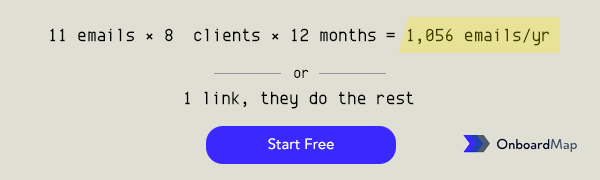
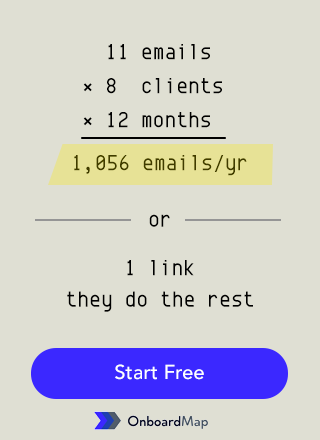
Now multiply. Two hours per client feels trivial. Two hours across eight new clients a month is sixteen hours, two full workdays, gone every month to admin. At an effective rate of 85 dollars an hour that is over 16,000 dollars a year. Push it to three hours per client and you are past 24,000 dollars. This is the onboarding time tax that scales with every client you win, and it is exactly the cost that makes growth feel heavier than it should.
Run your own numbers in the calculator at the top of this page. Change the client count, the hours, and your rate, and watch the annual figure move. Most people are surprised by how large it gets.
Where the Time Actually Goes
Not all onboarding time is equal, and this matters, because you do not want to automate the parts that build the relationship. Split the work into two buckets.
Repetitive, low-judgment work. Sending the same form, requesting the same documents, reminding the same forgetful clients, collecting files, and tracking status. This is mechanical. It follows rules. It is identical from one client to the next except for the name at the top. This is the bucket that eats the most hours and returns the least value, and it is almost entirely automatable.
Relationship and judgment work. The kickoff conversation, understanding the client’s real goals, adjusting your plan to their situation, the reassuring reply when they are nervous. This is where your expertise shows and where trust is built. You do not want to automate this away. You want to protect it.
The whole ROI argument rests on one idea: automation should delete the first bucket so you have more time and attention for the second. When people say automated onboarding feels cold, they usually mean someone automated the wrong bucket. Done right, automation makes onboarding feel more personal, because you are no longer buried in admin during the exact window when the client needs to feel taken care of.
Which Onboarding Tasks Pay to Automate?
Here is the task-by-task breakdown. For each one, the manual version, the automated version, and roughly how much time it frees.
Onboarding task
Manual version
Automated version
Time freed
Send intake form
Copy-paste, personalize, email, hope they open it
Auto-sent with the welcome, one link, no login
15 to 30 min
Collect documents
Ask, wait, follow up, re-ask, file manually
Client uploads to one place, filed automatically
30 to 60 min
Chase quiet clients
Remember to check, draft a nudge, send it
Automatic reminders trigger on inactivity
20 to 40 min
Answer repeat questions
Reply to the same questions one by one
Answers built into the flow up front
10 to 20 min
Track who did what
Update a spreadsheet or board by hand
Live status dashboard updates itself
15 to 30 min
Trigger the next step
Notice completion, manually start the next stage
Next stage fires the moment a client finishes
10 to 20 min
The two rows that dominate are document collection and chasing quiet clients, which is not a coincidence. Those are the same two stages where clients most often stall in the onboarding funnel. Automating them does double duty: it saves your time and it plugs the leaks where clients drop off. You get the hours back and the completion rate goes up at the same time.
Notice what is not on the list: the kickoff call, the strategy, the judgment. Those stay human on purpose. If you want the fuller picture of what breaks when people automate the wrong things, the common onboarding automation mistakes are worth reading before you start.
The ROI Math, Step by Step
You do not need a finance degree. The formula has four inputs and one subtraction.
Clients per month. How many new clients you onboard in a typical month.
Manual hours per client. The honest admin time from your inventory above, not counting real delivery work.
Value of an hour. Your billable rate, or your effective hourly cost if the person doing onboarding is on salary. Use whichever reflects what that hour is actually worth to the business.
Automation coverage. How much of the manual work the software realistically removes. Around 70% is a reasonable planning number for the repetitive bucket.
Multiply the first three to get your annual cost of manual onboarding. Multiply that by your automation coverage to get the recoverable amount. Subtract the software cost. What remains is your ROI, and for most service businesses onboarding more than a couple of clients a month, the software cost is a rounding error next to the recovered time.
An example. Eight clients a month, three hours each, 85 dollars an hour. That is 24 hours a month, worth about 2,040 dollars, or roughly 24,480 dollars a year. Recover 70% and you get back around 17,000 dollars of time annually. Software to do it runs a small fraction of that. The return is not marginal, it is lopsided.
And this undercounts the benefit, because it only measures your time. It ignores the second, larger payoff.
The ROI You Cannot Put in a Spreadsheet
The time savings are the easy part to measure. The bigger return is harder to quantify but usually worth more.
Faster time to first value. When onboarding runs itself, clients are not waiting on you to send the next thing. They move through the steps as fast as they are ready, and they reach their first real result sooner. Shorter time to first value is one of the strongest predictors of whether a client stays, so speeding it up is retention work disguised as efficiency work.
Lower churn in the first 30 days. A chaotic onboarding, silent stretches, repeated requests, the feeling of being forgotten, quietly convinces clients they made a mistake before you have delivered anything. Automation removes the silences that cause that doubt. Fewer clients ghost, fewer refunds, more make it to the point where your actual work can impress them.
A more professional first impression. One clean link, a clear path, reminders that arrive without you lifting a finger. It signals that you have your act together, which is exactly what a nervous new client is hoping to see. That impression compounds into referrals.
Headroom to grow. The manual cost per client is what makes owners feel they cannot take on more without hiring. Remove most of it and the same team can onboard far more clients without the wheels coming off. Automation is often cheaper than the admin hire you were about to make.
None of these fit neatly in the calculator, but they are the reason the real ROI is bigger than the hours suggest.
Do You Even Need Software for This?
Honest answer: not always. If you onboard one or two clients a month, a disciplined checklist, a saved email template, and the habit of following up promptly can carry you a long way. The question of software versus a better process is real, and buying a tool to paper over a fuzzy process just gives you a fuzzy automated process.
But the manual approach has a ceiling, and it is exactly the repetitive bucket that hits it first. Remembering who owes which document, personally nudging every quiet client, keeping a tracker current, and firing the next step by hand is manageable for two clients and impossible for twenty at once. The work does not get harder per client, there is just more of it happening in parallel than one person can hold in their head. That is the moment automation stops being a luxury and starts being cheaper than the alternative.
Purpose-built tools like OnboardMap are built for that exact bucket. You describe what you need in one sentence and it builds the whole onboarding, checklist, intake forms, and document requests, then sends each client one magic link with no login. It reads the files clients upload, reminds anyone who goes quiet automatically, and shows you a live view of exactly which step each client is on. The chasing, sending, reminding, and tracking, the four rows that dominated the cost table, run themselves. You keep the kickoff call and the strategy. Instead of stitching together a form tool, a shared drive, a project board, and your inbox, the client gets one clean path and you get your hours back.
Getting Started Without Overthinking It
You do not need to automate everything at once. Get the ROI flowing with the biggest rows first.
Week 1: Measure it. Time the admin on your next two or three clients and run the calculator above. Now the cost is a number, not a feeling.
Week 2: Automate document collection. This is usually the single biggest row and the one clients hate most. Move it to one upload spot with automatic reminders. For the specifics, see how to automate client onboarding.
Week 3: Automate the chasing and the status. Let reminders trigger themselves and let a live dashboard replace your manual tracker.
Week 4: Check the numbers. Re-time the admin on your newest clients. The gap between the old figure and the new one is your ROI, made real.
Manual onboarding does not announce its cost, which is exactly why it survives for so long in so many businesses. Put a number on it, automate the repetitive 70%, and keep your attention for the work only you can do. Run your figures in the calculator at the top, and when you are ready to stop chasing, try OnboardMap free and build your first automated onboarding in a few minutes.
Frequently Asked Questions
What is the ROI of client onboarding automation? The ROI of client onboarding automation is the value of the time you stop spending on manual onboarding admin, minus what the software costs. Most service businesses spend two to four unbilled hours per client sending forms, chasing documents, sending reminders, and updating status. Automating around 70% of that recovers dozens of hours a year, which usually outweighs the software cost several times over, before you count faster time to first value and lower churn.
How much time does manual client onboarding take? For a typical service business, two to four hours of hands-on admin per client is common: drafting and sending intake forms, following up on missing documents, answering the same questions, chasing signatures, and manually updating trackers or emailing status. It feels smaller because it is scattered across days, but multiplied by every new client it becomes one of the biggest hidden costs in the business.
Which parts of client onboarding should you automate? Automate the repetitive, low-judgment work: sending intake forms and document requests, reminding clients who go quiet, collecting and organizing uploaded files, tracking who has completed which step, and triggering the next stage when a client finishes theirs. Keep humans on the relationship work: the kickoff conversation, strategy, and judgment calls. Automation should remove the chasing, not the connection.
Is onboarding automation worth it for a small business? Usually yes, once you onboard more than a couple of clients a month. The math is simple: if automation saves even two hours per client and you onboard eight clients a month at an effective rate of 85 dollars an hour, that is over 13,000 dollars of recovered time a year, far more than the cost of the software. Below a client or two a month, a tight manual checklist may be enough.
Ready to fix your onboarding?
Send one link. Clients upload docs, fill intake forms, and complete every step — automatically tracked. No account required for your clients.
Austin Spaeth is the founder of OnboardMap, a client onboarding portal for service businesses. After years of watching agencies and consultancies lose time to scattered onboarding processes, he built OnboardMap to give every client a single link with everything they need to get started.
OnboardMap
Onboard clients in one sentence. Describe what you need and OnboardMap builds the whole onboarding, checklist, forms, and document requests, then sends one link and tracks every step for you.