3/29/2026
Case Studies
Every Bookkeeper Wastes 10 Hours a Month on Client Intake. Here Is the Fix.
Bookkeepers lose hundreds of hours a year chasing clients for documents. Here is how to automate your entire intake process and get that time back.
Whether you're onboarding new clients, collecting documents, or building intake forms, we'll help you get organized.
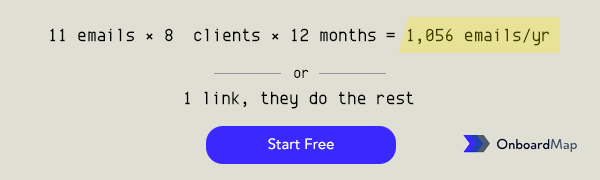
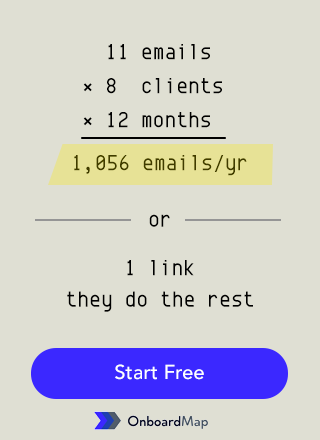
OnboardMap replaces email chaos with one link. Clients complete every step. You see progress instantly.

TLDR: PDF intake forms tank completion rates, trap your data, and look terrible on mobile. Switching to a digital intake form takes one afternoon and can push completion rates from 62% to 94% — while letting you automate reminders and route data straight into your tools.
Be honest. How does your intake process work right now?
If the answer involves a PDF attachment, a Word document, or (still) a paper form, you’re creating friction at the worst possible moment: the beginning of the client relationship.
PDFs had their era. That era is over. Here’s why digital intake isn’t just nicer, it’s necessary.
PDF forms seem harmless. You design one, save it, attach it to emails for years. But the hidden costs add up fast.
PDFs require downloading, opening in a compatible reader, filling out (sometimes the fields don’t even work), saving, and re-attaching to an email. Every extra step loses people. A bookkeeping firm that switched from PDF to an online form saw their intake completion rate jump from 62% to 94%. That’s a third of clients who were stalling before they even started.
When a client emails back a filled PDF, that data is trapped. You have to manually read it, copy it into your CRM or project management tool, and hope you don’t make a typo. There’s no automation possible with a PDF. Every submission means manual work.
Which version of the PDF is the latest? Did the client fill out the old one from 2023 that’s missing the new fields? Did they overwrite their answers and resend? You end up with multiple versions of the same form across different email threads.
Over 40% of clients will first open your intake form on their phone. Try filling out a PDF on a mobile device. Pinching, zooming, tiny text fields that don’t resize. Most clients give up and tell themselves they’ll do it later. “Later” often means “never.”
Digital intake means your client clicks a link, fills out a web-based form, and submits it. That’s it. No downloads, no file attachments, no compatibility issues.
A good digital intake setup includes:
This isn’t futuristic. This is what clients expect in 2026. If you’re still asking them to download a PDF, you’re signaling that your entire operation might be similarly outdated.
Does it? Ask yourself: How many follow-up emails do you send asking clients to complete the form? How many times do you manually enter data from a PDF into another system? “Works fine” usually means “we’ve gotten used to the pain.”
Many digital form tools have free tiers that handle basic intake. And even paid tools cost less per month than the billable hours you lose chasing down incomplete PDFs.
If your clients can fill out any online form anywhere, such as scheduling a doctor’s appointment, ordering food, or booking a flight, they can fill out a digital intake form. The interface is simpler than a PDF, not more complex.
Your digital form can look professional too. Branding, logos, custom colors. And it will actually function correctly on every device your client uses.
You don’t need to rebuild everything from scratch. Here’s the afternoon version:
For a ready-made structure, grab our client intake form template and adapt it to your digital form builder.
If you want to rethink the entire workflow while you’re at it, our guide on automating client onboarding covers what to automate beyond just the form.
This isn’t just about your efficiency. It’s about how your client feels.
A PDF says: “Here’s a file. Figure it out.”
A digital intake form says: “We’ve built a smooth process for you. We take this seriously. You’re in good hands.”
That perception matters. Clients who have a frictionless onboarding experience are more likely to trust you, respond faster, and refer others. The intake form is your first impression after the sale. Make it count.
For a deeper look at how intake fits into the broader client experience, read our comparison of client portals vs. email.
You can keep emailing PDFs. Nobody will stop you. But every PDF you send is a small tax on your client’s patience and your team’s time.
OnboardMap gives you digital intake forms with conditional logic, auto-reminders, file uploads, and a branded client portal, so your intake process finally matches the quality of your work. Get early access and leave the PDFs behind.
Send one link. Clients upload docs, fill intake forms, and complete every step — automatically tracked. No account required for your clients.
Austin Spaeth is the founder of OnboardMap, a client onboarding portal for service businesses. After years of watching agencies and consultancies lose time to scattered onboarding processes, he built OnboardMap to give every client a single link with everything they need to get started.
Client onboarding portal that replaces email chaos. Send one link. Clients upload everything, complete every step, and you see progress instantly.
Start For FreeFree plan includes 3 onboardings/mo.