3/29/2026
Case Studies
Every Bookkeeper Wastes 10 Hours a Month on Client Intake. Here Is the Fix.
Bookkeepers lose hundreds of hours a year chasing clients for documents. Here is how to automate your entire intake process and get that time back.
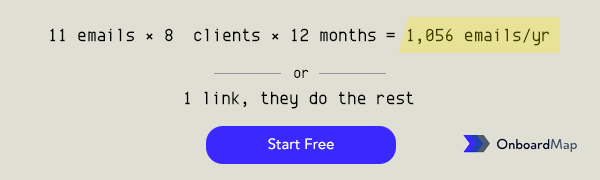
Whether you're onboarding new clients, collecting documents, or building intake forms, we'll help you get organized.
OnboardMap replaces email chaos with one link. Clients complete every step. You see progress instantly.
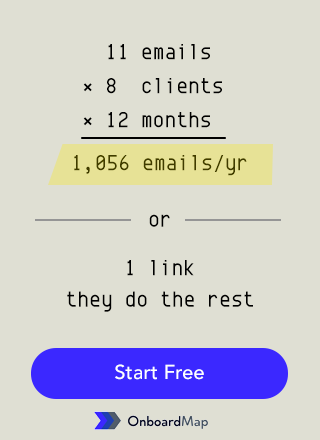

TLDR: The average bookkeeper spends over 10 hours every month on manual client intake — writing follow-up emails, updating tracking spreadsheets, and searching inboxes for missing documents. That is 120+ hours a year of zero-revenue work. An automated intake system with itemized checklists, secure uploads, and status-based reminders can cut that by 80%. Here is exactly how to set one up.
Let’s do some math that will make you uncomfortable.
You have 30 bookkeeping clients. Each one needed an average of 8 documents when they onboarded. You sent the initial request email. Then you sent a follow-up three days later. Then another the following week. You checked your spreadsheet, cross-referenced your inbox, and wrote personalized “just circling back” emails to 14 of them.
Total time spent per client on intake admin: roughly 20 minutes.
Multiply that by 30 clients. That is 10 hours. Every month. Just on intake follow-ups and tracking.
Now multiply by 12 months. That is 120 hours a year — three full work weeks — spent on work that generates zero revenue and that your clients do not enjoy either.
The fix is not working harder. It is not hiring a virtual assistant. It is replacing the manual process with a system that runs itself.
The time drain is not one big task. It is dozens of small, repetitive ones that add up fast.
Every new client gets some version of the same message: “Welcome aboard. Here is what I need from you.” But you write it fresh each time, or you dig through your sent folder to find the last version, tweak it, and hit send.
Then the follow-ups start. “Did you get my email?” “I still need your bank statements.” “Can you resend the W-9? The attachment was blank.” Each one takes 2-3 minutes. You send dozens per month.
You have a spreadsheet — or maybe a checklist in a Google Doc — where you manually check off which clients have sent which documents. Every time a client emails you a file, you download it, rename it, file it, and update the tracker. If you forget to update the tracker, you send a reminder for something you already have. The client loses confidence in your process.
Clients send documents in every format imaginable: email attachments, text messages, Google Drive links, Dropbox shares, photos of paper documents. Half your intake time is not collecting documents — it is finding and organizing the ones you already received.
“What format should the bank statements be in?” “Do you need all 12 months or just the last quarter?” “Where do I find my EIN letter?” You answer these questions individually, over and over, because there is no central place where clients can find the answers themselves.
Here is the workflow you should be running instead.
Create a single, reusable template that lists everything you need from a new bookkeeping client:
Documents to collect:
Intake forms to complete:
Tasks to finish:
You build this once. You use it for every client. Customize by adding or removing items based on client type — individual vs. business, new vs. returning — but the core stays the same.
When a new client signs on, you send them a single link to their onboarding portal. Not a 2,000-word email with 14 attachments. Not a shared Google Drive folder with confusing naming conventions. One link.
They click it. They see a clear checklist of everything they need to do. Each item has a description explaining exactly what it is and why you need it. They can upload files, fill out forms, and check off tasks from their phone, tablet, or computer. No account creation required. They access it through a magic link — click and they are in.
This is the part that saves you 10 hours a month.
Instead of manually checking your tracker and writing follow-up emails, the system sends automated reminders based on what is actually missing. Not a generic “please send your documents” blast. A specific, personalized nudge:
“Hi Sarah — you have uploaded 5 of 9 items. Here is what we still need: 12-month bank statements for Chase checking account, Q3 and Q4 credit card statements, and your QuickBooks Online login.”
The reminders go out automatically. You set the cadence — 3 days, 7 days, 14 days — and the system handles the rest. You only step in for the clients who genuinely need a phone call.
Replace your spreadsheet with a real-time dashboard that shows every client’s intake status at a glance:
You open this dashboard once a day. In 60 seconds, you know exactly where every client stands. Compare that to the 30+ minutes of spreadsheet checking and inbox searching you do now.
Bookkeepers who move from email-based intake to a portal-based system typically see:
And the client experience transforms too. Instead of feeling nagged by your emails, clients see a clean, professional portal with a progress bar. They know exactly what is expected. They can work through it at their own pace. They feel organized — and they associate that feeling with you.
Everything above applies year-round. But during tax season, the stakes multiply.
If you onboard or re-engage 50 clients between January and April, and each one requires a document collection checklist of 10+ items, you are looking at 500+ individual document transactions. Managing that through email is not just inefficient — it is a guarantee that something critical will fall through the cracks.
An automated intake system turns tax season from a four-month fire drill into a structured process:
Clients who finish early get their returns filed early. Clients who are slow get escalated. Nothing gets lost.
The real question is not whether you can afford to automate intake. It is whether you can afford not to.
120 hours per year of follow-up time at even a modest $50/hour is $6,000 in lost productivity. That is before you count:
For context, a tool like OnboardMap starts at $29/month and has a free plan that covers 3 onboardings per month. The math is not close.
You did not become a bookkeeper to spend a quarter of your week writing reminder emails and updating spreadsheets. You did it to help businesses get their finances right.
Every hour you spend on intake admin is an hour you are not spending on client work, business development, or the parts of the job you actually enjoy. The tools exist to eliminate this problem. The only question is how long you are willing to keep doing it the hard way.
Try OnboardMap free and set up your first automated intake in 10 minutes. No credit card required. Your inbox will thank you.
Send one link. Clients upload docs, fill intake forms, and complete every step — automatically tracked. No account required for your clients.
Austin Spaeth is the founder of OnboardMap, a client onboarding portal for service businesses. After years of watching agencies and consultancies lose time to scattered onboarding processes, he built OnboardMap to give every client a single link with everything they need to get started.
Client onboarding portal that replaces email chaos. Send one link. Clients upload everything, complete every step, and you see progress instantly.
Start For FreeFree plan includes 3 onboardings/mo.