TLDR: You can outsource client onboarding to a virtual assistant, systematize it with software, or keep doing it by hand. A VA absorbs the labor but not the chaos, so it only works when your process is already clean and your volume is low. Software removes the manual steps entirely and scales without headcount, which fits most repeatable service businesses. DIY only makes sense under about five clients a month. For most owners the honest answer is software first, then a person for the human parts, not a person to run a broken manual process.
There is a specific point in a growing service business where a thought arrives, usually on a Friday afternoon while you are still chasing a document you asked for on Monday: I need to hire someone to handle onboarding.
It feels obvious. The work is repetitive, it does not require your particular expertise, and it is swallowing hours you should be spending on billable work or sales. So you start drafting a job post for a virtual assistant.
Before you do, it is worth slowing down for ten minutes, because the “just hire someone” instinct skips a question that changes the whole decision: is the problem the labor, or the process? If you outsource client onboarding without answering that, you can spend real money and still feel just as buried three months later. This guide lays out the three honest options (do it yourself, hire a VA, or use software), the cost math behind each, and the signals that tell you which one actually fits.
The three ways to handle client onboarding
Every service business handles onboarding admin in one of three ways, whether they chose it deliberately or drifted into it:
DIY. You or a team member runs onboarding by hand: writing welcome emails, requesting documents, following up, updating a tracker.
Outsource it to a person. You hand the process to a virtual assistant, onboarding coordinator, or admin who does the same manual steps on your behalf.
Systematize it with software. You put the repeatable steps into a tool that runs them automatically: one portal link per client, self-service document collection, automated reminders, live status tracking.
These are not mutually exclusive, and the best answer for a lot of businesses is a combination. But they fail in different ways and cost very different amounts, so it helps to look at each one honestly.
Option 1: Keep doing it yourself
DIY is not a failure state. Under about five new clients a month, doing onboarding by hand is often the right call. The overhead of hiring and training a person, or of rolling out and learning a tool, can genuinely outweigh the few hours a week you would save.
The problem is not DIY at low volume. The problem is DIY out of habit past the point where it pays. Here is the tell: onboarding admin has become a recurring line item on your week, you have missed at least one follow-up in the last month, and clients have started sending documents to the wrong place. When you are there, the hidden cost of doing it yourself has already passed the cost of a system. We break the full number down in the onboarding team time tax and the owner trap of running every onboarding yourself.
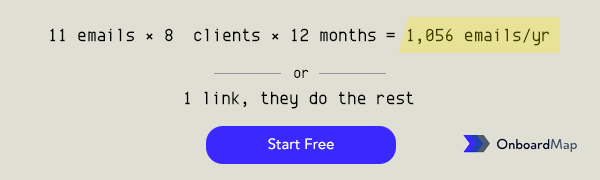
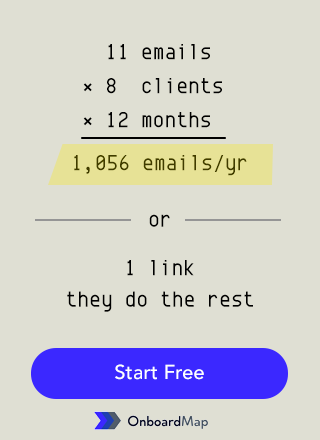
The honest math: a typical email-based onboarding costs 2.5 to 4.5 hours of coordination per client. At ten clients a month, that is 25 to 45 hours, or roughly a third of a full-time role, spent shuffling information rather than doing the work clients pay for.
Option 2: Outsource it to a virtual assistant
This is the instinct most owners reach for, and it can work well. A good VA or onboarding coordinator takes the emotional weight off your plate, sends the welcome notes, chases the quiet clients warmly, and keeps the tracker current.
But there is a trap hiding inside it, and it is worth saying plainly:
Hiring a person absorbs the labor. It does not absorb the chaos.
If your onboarding process is undocumented, scattered across your inbox, and different for every client, a VA does not fix that. They inherit it. You are now paying someone 800 to 2,500 dollars a month to run the same messy, manual process you were running, and the mess does not get cheaper, it just moves off your desk. Worse, you have added a training burden, a management burden, and a single point of failure. When your VA takes a week off, onboarding stops.
A VA is the right answer when three things are true:
Your process is already documented and repeatable, so you are handing over a system, not a mess.
The work that eats your time is genuinely human: warm follow-up, judgment calls, scheduling gymnastics, answering nuanced questions.
Your volume is steady but moderate, so one person can actually keep up without the process breaking.
If you are going this route, get the process out of your head and onto paper first. A written SOP and clear onboarding roles is the difference between handing over a system and handing over a headache.
Option 3: Systematize it with software
The third option attacks a different part of the problem. Instead of finding a person to do the manual steps, you remove the manual steps.
Most of what makes onboarding painful has no judgment in it at all. Telling a client what documents to send and where. Nudging the ones who went quiet at 48 hours and again at five days. Updating a status tracker. Forwarding files from your inbox to the right team member. Answering “did you get my email?” for the tenth time. None of that requires a human brain. It requires a system that never forgets and never takes a day off.
Purpose-built client onboarding software handles exactly this layer: each client gets one link (no login), completes intake and uploads documents on their own time, gets reminded automatically when they stall, and your whole team sees live progress. It costs a fraction of a person, and it scales without adding headcount. Ten clients or fifty, the software does the same work.
What software cannot do is the relationship. It will not run the welcome call, read a delicate situation, or reassure a nervous client. That is a feature, not a gap. It means you keep your people focused on the 20% of onboarding that actually needs them, and hand the other 80% to a system. For the full argument on when a tool beats a better manual process, see do you need onboarding software or a better process?
The cost comparison, side by side
Here is the honest picture across the three options for a business onboarding around fifteen clients a month.
DIY
Virtual assistant
Onboarding software
Typical monthly cost
“Free” (your time)
800 to 2,500 dollars
Fraction of a VA
Real cost
35 to 65 hours of your team
Salary plus training and management
Subscription plus light setup
Scales with volume?
No, breaks with growth
Only by hiring more people
Yes, same effort at any volume
Consistency
Depends on the day
Depends on the person
Identical every time
Handles the human parts
Yes
Yes
No (by design)
Fails when
Volume rises
Process is undocumented
You expect it to build the relationship
Best fit
Under 5 clients a month
Clean process, moderate volume
Repeatable, growing volume
The row that matters most is “scales with volume.” DIY and a single VA both scale linearly: double the clients, roughly double the hours or add another hire. Software breaks that line, which is why it is usually the first move for any business that intends to grow. We walk through the underlying software cost breakdown if you want the numbers in detail.
The answer most businesses land on: software plus a person
Framing this as “VA versus software” makes it sound like a fork in the road. For most growing service businesses, it is not. It is a stack.
Put the repeatable, no-judgment work on software. The portal, the document collection, the reminder cadence, the status tracking. This is the 80% that has been eating your week, and it is the part a tool does more reliably than any human.
Keep a person on the human layer. The welcome call, the exceptions, the relationship. This is the 20% that clients actually notice, and it is where a great VA or account manager earns their keep, once they are freed from the busywork.
Done this way, you get consistency and scale from the software and warmth and judgment from the person. You are not paying someone to send reminder emails a system can send for free. And when volume triples, the software absorbs it while your one person keeps doing the part that needed a human all along. This is the same logic behind onboarding 10x more clients without hiring anyone: you do not remove the people, you remove the manual steps the people were stuck doing.
A five-minute self-check before you decide
Before you post a job or start a trial, answer these. Your answers point clearly at one of the three options.
How many new clients do you onboard in a typical month? Under 5 leans DIY. 5 to 20 leans software. 20+ almost always needs software plus a person.
Is your onboarding process written down anywhere? If no, do not outsource yet. You would be outsourcing chaos. Document it first.
What actually eats the time? If it is mechanical (chasing documents, reminders, tracking), that is a software problem. If it is relational (calls, judgment, reassurance), that is a people problem.
What happens if the person running onboarding is out for a week? If the answer is “everything stops,” you have a single-point-of-failure risk that software removes.
Are things currently falling through the cracks? Missed follow-ups and lost documents are a signal that the process, not the effort, is the problem. More effort (a new hire) will not fix a process problem.
If most of your pain is mechanical and repeatable, start with software and add a person for the human parts. If your process is clean and your bottleneck is genuinely human warmth at moderate volume, a VA is a fine call. If you are under five clients a month, keep doing it yourself and revisit this when the volume climbs.
Frequently asked questions
Should I outsource client onboarding to a virtual assistant? A VA works when your process is documented and repeatable, your volume is steady, and the time-consuming work is genuinely human. It backfires when you hand over an undocumented mess, because you end up paying someone to run the same chaos. Fix the process first, then decide whether a person or software should carry it.
Is onboarding software cheaper than hiring a VA? Usually by a wide margin. A part-time VA on onboarding runs 800 to 2,500 dollars a month; purpose-built software runs a fraction of that and never forgets a follow-up. The strongest setup pairs software for the routine work with a person for the relationship work.
What parts of onboarding should never be outsourced or automated? The relationship and the judgment: the welcome conversation, understanding a client’s specific situation, handling a sensitive handoff, and answering nuanced scope questions. Automate the mechanical parts and protect the human ones.
When is it fine to keep doing onboarding myself? Under roughly five new clients a month. Past that, once onboarding admin costs you more than a few hours a week or you are missing follow-ups, a system pays for itself.
Can I outsource onboarding and use software at the same time? Yes, and that is the strongest setup for most growing businesses. Software handles the repeatable steps and a person handles the human layer on top.
The bottom line
The question is not really “should I hire someone for onboarding?” It is “what part of onboarding needs a human, and what part just needs a system?” Answer that, and the decision makes itself. Most of the work draining your week (the chasing, the reminding, the tracking) needs a system. The small, high-value part that is left needs a person.
If you want to see what it looks like to hand the mechanical 80% to software, one link per client, self-service document collection, automated follow-ups, and live progress for your whole team, OnboardMap was built for exactly that. It replaces the manual busywork so the people you do keep can spend their time on the work clients actually chose you for.
Austin Spaeth is the founder of OnboardMap, a client onboarding portal for service businesses. After years of watching agencies and consultancies lose time to scattered onboarding processes, he built OnboardMap to give every client a single link with everything they need to get started.
OnboardMap
Onboard clients in one sentence. Describe what you need and OnboardMap builds the whole onboarding, checklist, forms, and document requests, then sends one link and tracks every step for you.