Try OnboardMap Free

Start Here

Whether you're onboarding new clients, collecting documents, or building intake forms, we'll help you get organized.

Stop Chasing Clients

OnboardMap replaces email chaos with one link. Clients complete every step. You see progress instantly.

  • ✓ Step-by-step onboarding checklists
  • ✓ Document uploads & intake forms
  • ✓ Automatic reminders & nudges
No credit card required
Try OnboardMap Free

Recent Onboarding Articles

9/25/2026
Onboarding

The IKEA Effect in Client Onboarding: Why Clients Value the Setup They Help Build

Doing all the setup for a new client feels like great service, but it quietly costs you loyalty. The IKEA effect shows why clients value the onboarding they help build, and how to put them in the builder's seat without adding friction.

9/24/2026
Onboarding

Client Offboarding: The Checklist That Protects Your Data, Reputation, and Referrals

Most service businesses have an onboarding process and nothing at the other end. A deliberate client offboarding process protects your data, closes out access cleanly, and turns a departing client into a referral source. Here is the full checklist.

9/23/2026
Onboarding

Client Onboarding E-Signatures: Get Contracts Signed Without Stalling the Whole Process

The signature is where onboarding quietly stalls. A contract sits unsigned for a week, and everything downstream waits with it. Here is how to collect e-signatures as part of onboarding so nothing gets stuck at the signing step.

9/22/2026
Onboarding

Productized Service Onboarding: The Repeatable System Your Offer Actually Needs

A productized service promises the same result at the same price every time. If your onboarding is still custom for every client, you do not really have a productized service. Here is how to build onboarding that runs like the rest of your offer: once, the same way, at scale.

9/21/2026
Onboarding

The Onboarding Handoff: How to Move a Client From Setup to Real Work Without Dropping the Ball

Everyone talks about the sales-to-onboarding handoff. Almost nobody plans the second one: moving a client from setup into ongoing delivery. That seam is where good onboarding quietly falls apart. Here is how to close it.

9/20/2026
Onboarding

How to Collect a Deposit Before Client Work Starts (Without the Awkward Money Talk)

If you start work before the deposit clears, you are financing your client's project. Here is how to make paying the deposit a normal, tracked step in your onboarding, so you get paid up front without the awkward money conversation.

9/18/2026
Onboarding

How to Onboard Non-Technical Clients Without the Tech-Support Headaches

Some of your best clients are your least tech-savvy ones. This guide shows how to onboard non-technical clients without becoming their unpaid help desk: remove logins, cut steps, and let the tool do the chasing.

9/17/2026
Documents

Google Drive vs. a Client Portal for Collecting Client Documents

A shared Google Drive or Dropbox folder feels like the obvious way to collect documents from clients. This guide compares it to a purpose-built client portal on security, tracking, reminders, and client friction, and shows when each one is the right call.

9/16/2026
Onboarding

Client Onboarding During Your Busy Season: How to Handle a Surge Without Dropping Clients

Every service business has a busy season, and it is exactly when client onboarding falls apart. Here is how to absorb a surge of new clients without slow starts, missed reminders, and a first impression you spend months apologizing for.

9/15/2026
Onboarding

How to Automate Client Onboarding with HubSpot: Workflows, Deal Stages, and the One Gap to Watch

HubSpot can automate most of the internal machinery of client onboarding through Workflows and deal stages. Here is exactly how to build it, what each HubSpot tier gives you, and the one client-facing gap you still have to fill.

9/14/2026
Onboarding

Client Onboarding Software vs. Project Management Tools (Asana, Notion, Monday)

Asana, Notion, and Monday are built to organize your team's work, not to onboard your clients. Here is exactly where a project management tool fits, where it breaks for client-facing onboarding, and how to decide when to switch to purpose-built client onboarding software.

9/13/2026
Documents

How to Collect Logins and Account Access from Clients Securely

Agencies, MSPs, and consultants often need a client's account access to start work. This guide covers the secure ways to collect logins and credentials during onboarding, what to request, and how to keep passwords out of email.

9/12/2026
Onboarding

Client Onboarding Friction: How to Find It and Remove It

Onboarding friction is every small point where a client has to stop, think, or wait. This guide shows you how to map it, score it, and remove the pieces that quietly cost you clients.

9/11/2026
Onboarding

Client Onboarding in Airtable: Build a Tracker (and When to Outgrow It)

A step-by-step guide to building a client onboarding tracker in Airtable, with the exact base structure, linked records, single-select statuses, rollup formulas, views, forms, and automations to copy, plus the honest client-facing limits that tell you when to move to purpose-built software.

9/10/2026
Onboarding

Enterprise Client Onboarding: How Small Teams Win and Keep Bigger Accounts

Landing an enterprise client is a different sport than onboarding a small one: more stakeholders, a security review, procurement, and no room for a sloppy start. Here is how a small team runs a credible enterprise onboarding without hiring an onboarding department.

Show more articles
Client Retention Starts with Onboarding: How the First 30 Days Decide Everything
© Photo by Cytonn Photography on Unsplash

Client Retention Starts with Onboarding: How the First 30 Days Decide Everything

TLDR: If clients are churning, don’t blame the deliverables — look at your first 30 days. Three moments define whether a client stays or leaves: the first email after signing, the first time you ask them for something, and the first status update. Nail those three with a structured process and retention practically takes care of itself.

The Retention Problem Nobody Talks About

When a client leaves, most teams blame the deliverable. The project went sideways. The results weren’t there. The relationship just “didn’t work out.”

But if you trace it back, the cracks almost always started in onboarding.

Research from the Customer Success Association shows that 23% of client churn can be attributed to poor onboarding. Not poor performance. Not pricing. Onboarding.

And it makes sense. The first 30 days are when clients are forming their opinion of you. They’re watching how you communicate, how organized you are, and whether working with you feels easy or exhausting.

Get this wrong and no amount of great work later will undo the damage.

Why First Impressions Stick

There’s a psychological principle called the primacy effect — people disproportionately remember and weight the first experience in a series. In client relationships, that first experience is onboarding.

Here’s what your client is actually evaluating during those first 30 days:

  • “Do these people have their act together?” — Is there a process, or does it feel improvised?
  • “Do they understand my situation?” — Did they ask the right questions, or just generic ones?
  • “Is this going to be easy or painful?” — Are they organized, or am I already chasing them for things?

If the answer to any of those is negative, your client is already mentally preparing their exit — even if they won’t act on it for six months.

The 3 Moments That Make or Break Retention

Not every interaction matters equally. In the first 30 days, three specific moments carry outsized weight.

Moment 1: The First Email After Signing

This is your handoff from sales to delivery. And for most businesses, it’s a disaster.

The client signs. Then silence. Or worse — a generic “Welcome aboard!” email with a PDF attachment and no clear next step.

The fix: Send a personalized welcome within two hours of signing. Include a clear timeline of what happens next, who their point of contact is, and one specific action they need to take. For a complete framework on doing this well, see our guide on how to set client expectations during onboarding. Structure beats enthusiasm every time.

A client portal handles this automatically. The client clicks a link, sees their personalized onboarding dashboard, and knows exactly what to do. No guesswork.

Moment 2: The First Deliverable Request

The first time you ask a client to do something — send a document, fill out a form, provide access — you’re testing the relationship.

If that request comes as a vague email (“Can you send over your financials when you get a chance?”), you’ve created ambiguity. The client doesn’t know what format you need, what deadline matters, or where to send it.

The fix: Make every request specific, structured, and easy to complete. “Please upload your last three months of P&L statements in PDF format by Friday using this link.” One sentence. No confusion.

Moment 3: The First Status Update

Your client is wondering what’s happening. They signed. They sent you stuff. Now what?

If the first update they get is a 45-minute meeting with no agenda, you’ve wasted their time and signaled that your process is reactive.

The fix: Send a brief written update within the first 7-10 days. Cover what you’ve reviewed, what you’ve found, and what happens next. Keep it under 200 words. This is not a report — it’s a signal that you’re paying attention.

The Numbers Behind Structured Onboarding

Here’s what the data shows when teams formalize their onboarding process:

  • Churn reduction of 15-30% in the first year (Totango, 2024 benchmarks)
  • Time-to-value decreases by 40% when clients complete onboarding tasks on schedule
  • NPS scores jump 20-25 points when clients rate the onboarding experience as “excellent”
  • Upsell rates increase by 18% among clients who had a structured onboarding vs. ad hoc

The pattern is clear. Structured onboarding is not a nice-to-have. It’s the highest-leverage retention investment you can make.

Structure Beats Charm

Some teams try to compensate for a messy onboarding with personality. Extra calls. Friendly check-ins. “Just wanted to touch base!”

That’s not a strategy. That’s noise.

Clients don’t want more of your time during onboarding. They want less friction. They want to know what’s happening, what they need to do, and that you have a plan.

Compare the experience:

Scattered approach: Five emails asking for different things, a shared Google Drive folder that’s half-organized, a kickoff call with no agenda, and a follow-up that says “Let me know if you have questions!”

Structured approach: A branded portal with their name on it, a step-by-step task list, secure document uploads, automatic reminders, and a progress tracker they can check anytime.

The second version doesn’t require more effort. It requires a system. For a deeper comparison, see client portal vs. email.

How to Fix Your First 30 Days

Here’s the playbook:

  1. Map your current onboarding — write down every step, email, and request that happens in the first month
  2. Identify the gaps — where do clients stall, get confused, or go silent?
  3. Standardize the process — turn your best onboarding into a repeatable template (our guide on building a client onboarding workflow from scratch walks through this step by step)
  4. Automate the logistics — task assignments, reminders, document collection
  5. Keep the human moments human — the welcome message, the first update, the kickoff call

This isn’t about removing the personal touch. It’s about building best practices that make the personal moments possible by eliminating the administrative chaos around them.

Retention Is a First-30-Days Problem

You don’t need a loyalty program. You don’t need quarterly business reviews. You need an onboarding process that makes your client think, “These people know what they’re doing.”

For the complete data-backed framework on exactly how to reduce early churn, see our guide on how to reduce client churn by 40% in the first 30 days. And for industry-wide benchmarks on what “good” onboarding looks like across agencies, accountants, MSPs, and more, check out the 2026 Client Onboarding Benchmark Report.

OnboardMap helps you build that experience — branded portals, automated task tracking, secure document collection, and a client-facing dashboard that makes your first 30 days feel effortless. Get early access.
Ready to fix your onboarding?

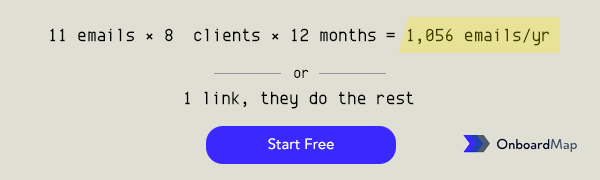
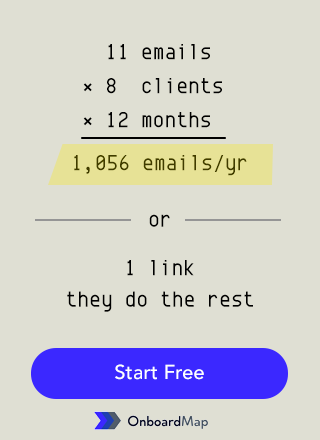
Send one link. Clients upload docs, fill intake forms, and complete every step — automatically tracked. No account required for your clients.

First onboarding free. No credit card required.

Related articles

The IKEA Effect in Client Onboarding: Why Clients Value the Setup They Help Build

9/25/2026

Doing all the setup for a new client feels like great service, but it quietly costs you loyalty. The IKEA effect shows why clients value the onboarding they help build, and how to put them in the builder's seat without adding friction.

Client Offboarding: The Checklist That Protects Your Data, Reputation, and Referrals

9/24/2026

Most service businesses have an onboarding process and nothing at the other end. A deliberate client offboarding process protects your data, closes out access cleanly, and turns a departing client into a referral source. Here is the full checklist.

Retainer Client Onboarding: How to Onboard Clients for Ongoing Work

9/3/2026

Retainer clients need a different onboarding than project clients. Here is how to build a client onboarding process for ongoing work that protects margin and keeps clients for years.

Austin Spaeth

Austin Spaeth is the founder of OnboardMap, a client onboarding portal for service businesses. After years of watching agencies and consultancies lose time to scattered onboarding processes, he built OnboardMap to give every client a single link with everything they need to get started.

OnboardMap

Onboard clients in one sentence. Describe what you need and OnboardMap builds the whole onboarding, checklist, forms, and document requests, then sends one link and tracks every step for you.

Start For Free