3/29/2026
Case Studies
Every Bookkeeper Wastes 10 Hours a Month on Client Intake. Here Is the Fix.
Bookkeepers lose hundreds of hours a year chasing clients for documents. Here is how to automate your entire intake process and get that time back.
Whether you're onboarding new clients, collecting documents, or building intake forms, we'll help you get organized.
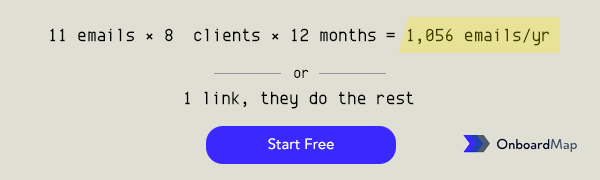
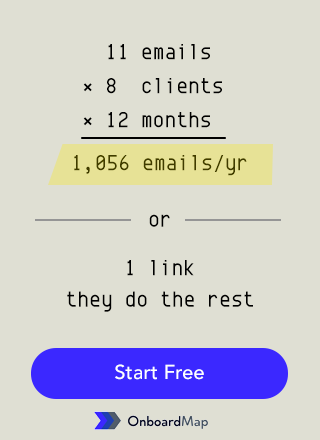
OnboardMap replaces email chaos with one link. Clients complete every step. You see progress instantly.

TLDR: When choosing a secure file upload tool for client onboarding, demand encryption in transit and at rest, role-based access controls, audit trails, and retention policies as non-negotiables. But security alone is not enough — if the tool is harder to use than email, your clients will just email you the files anyway.
Your clients are sending you Social Security numbers, bank statements, tax returns, contracts, and government-issued IDs. If those files are traveling through unencrypted email or sitting in a shared Google Drive folder with loose permissions, you have a problem.
It is not a hypothetical problem, either. A single data breach can cost a small firm $120,000 to $1.24 million in remediation, legal fees, and lost clients. And “we used email” is not a defense regulators will accept.
You need a secure file upload solution. But not all of them are worth your money.
When evaluating any file upload tool for client onboarding, these five features are baseline requirements. If a tool is missing any of them, move on.
Every file your client uploads should be encrypted the moment it leaves their browser. This means the connection between their device and the server uses TLS 1.2 or higher. Look for HTTPS across the entire application — not just the login page.
This prevents anyone from intercepting files while they are being uploaded. It is the equivalent of a sealed envelope versus a postcard.
Once files land on the server, they should stay encrypted. The industry standard is AES-256 encryption, the same standard used by banks and government agencies. This means that even if someone gains unauthorized access to the server’s storage, the files are unreadable without the encryption keys.
Ask the vendor directly: “Are files encrypted at rest, and what encryption standard do you use?” If they cannot give you a clear answer, that tells you everything.
Not everyone on your team needs access to every client’s documents. A proper file upload system lets you set role-based permissions:
This is especially important for firms with multiple staff members handling different client accounts. The bookkeeper working on Client A should not be able to browse Client B’s tax returns.
You need a record of who uploaded what, when they uploaded it, and who accessed it afterward. This is not just good practice — it is a compliance requirement for many regulated industries.
An audit trail should log:
If a client ever disputes whether they submitted a document, or a regulator asks how you handled sensitive data, the audit trail is your proof.
You should not be storing client documents indefinitely without a policy. Look for tools that let you set retention periods — for example, automatically deleting uploaded files 90 days after a project closes. This reduces your liability surface and keeps you aligned with data minimization principles.
Beyond the basics, these features separate good tools from great ones:
Here is where most secure file upload tools fail: they are painful to use.
Bank-grade security means nothing if your client cannot figure out how to upload a PDF. The best secure upload tool in the world is useless if clients give up halfway through and just email you the file anyway.
When evaluating usability, test the client experience yourself:
The tools that replace email for document collection need to be easier than email, not harder. Otherwise, clients will default back to their inbox.
Dropbox, Google Drive, and OneDrive are fine for internal file sharing. They are not built for client document management during onboarding.
Here is why:
A purpose-built client onboarding portal combines secure file uploads with structured workflows, progress tracking, and communication — all in one place.
Before committing to a secure file upload tool, ask these questions:
The answers will tell you whether the vendor takes security seriously or just checks boxes on a marketing page.
OnboardMap provides encrypted file uploads, role-based access controls, and full audit trails — wrapped in a client experience so simple that your least tech-savvy client can complete it on their phone. No accounts to create. No folders to navigate. Just a clear list of what to upload and a drag-and-drop interface.
Get early access to OnboardMap and give your clients a secure, simple way to send you their documents.
Send one link. Clients upload docs, fill intake forms, and complete every step — automatically tracked. No account required for your clients.
Austin Spaeth is the founder of OnboardMap, a client onboarding portal for service businesses. After years of watching agencies and consultancies lose time to scattered onboarding processes, he built OnboardMap to give every client a single link with everything they need to get started.
Client onboarding portal that replaces email chaos. Send one link. Clients upload everything, complete every step, and you see progress instantly.
Start For FreeFree plan includes 3 onboardings/mo.