3/29/2026
Case Studies
Every Bookkeeper Wastes 10 Hours a Month on Client Intake. Here Is the Fix.
Bookkeepers lose hundreds of hours a year chasing clients for documents. Here is how to automate your entire intake process and get that time back.
Whether you're onboarding new clients, collecting documents, or building intake forms, we'll help you get organized.
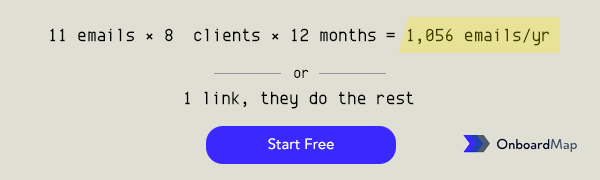
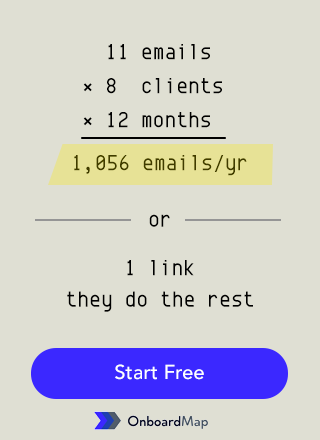
OnboardMap replaces email chaos with one link. Clients complete every step. You see progress instantly.

TLDR: Every bookkeeper knows the feeling: you send a document request, wait three days, follow up, wait again, follow up again , and the client finally sends half of what you asked for. This cycle is not a minor annoyance. It is a structural problem that is draining your time, capping your revenue, and burning you out. This article quantifies exactly how much the document chase is costing your practice, diagnoses the specific gaps in your onboarding process, explains the psychology behind why clients don’t respond, and lays out a step-by-step system to eliminate document chasing entirely.
It is 9:47 AM on a Tuesday. You have been at your desk for an hour. You have not opened a single set of books. Instead, you have sent four follow-up emails, re-forwarded a document checklist that a client says they never received (they did), and spent eleven minutes searching your inbox for a bank statement that was sent as a reply to an unrelated thread six days ago.
This is not bookkeeping. This is document chasing. And if you are being honest with yourself, it is the single biggest time sink in your practice.
You did not start a bookkeeping practice to become a professional email nagger. You started it because you are good with numbers, you understand financial systems, and you wanted to build something. But somewhere between client number five and client number twenty, the administrative overhead swallowed the actual work. Now you spend more time asking for documents than you do working with them.
And the worst part? Most bookkeepers have accepted this as normal. It is not normal. It is a solvable problem. And solving it is worth more to your practice than landing your next three clients.
Here is what happens when bookkeepers try to estimate how much time they spend on document chasing: they dramatically undercount.
That is because the document chase is not one activity. It is dozens of micro-tasks scattered throughout your day, each one small enough to feel insignificant but collectively devastating to your productivity:
None of these tasks take more than a few minutes. But they happen constantly, for every client, every month. And they add up to a number that will make you uncomfortable.
Use the calculator below to see what the document chase is actually costing your specific practice:
Take a moment with those numbers. That is not theoretical. That is time you have already spent , time you cannot bill for, time you cannot use to take on another client, time you cannot spend with your family or on growing your practice.
For a solo bookkeeper with 20 clients spending 25 minutes per client per week on document-related admin, that is roughly 33 hours per month. At $65 per hour, that is $2,145 per month in lost revenue , over $25,000 per year , spent on work that adds zero value and that your clients do not even appreciate.
That is not a rounding error. For many solo practitioners, that number represents the difference between a sustainable practice and one that is slowly grinding its owner down.
Before we fix the system, we need to understand why the current one fails. Because here is the thing: your clients are not ignoring you on purpose. They are not lazy, careless, or disrespectful. They are caught in a set of psychological traps that make document submission feel harder than it actually is.
Understanding these traps is important because it changes the solution. The answer is not to send more emails, louder emails, or more urgent emails. The answer is to redesign the experience so that these traps never trigger in the first place.
When you send a client an email that says “Please provide the following: W-9, bank statements for the last three months, prior year tax return, QuickBooks login credentials, payroll reports, sales tax filings, and articles of incorporation,” you are not sending one request. You are sending seven.
The client reads the list, realizes they do not have all of these things readily available, and their brain makes a calculation: “I cannot do all of this right now, so I will do it later.”
“Later” becomes tomorrow. Tomorrow becomes next week. Next week becomes “I really need to get to that.”
This is called the overwhelm cascade. The longer the list, the less likely the client is to start. Not because each item is hard, but because the collection feels hard as a whole.
What works instead: Break the request into sequential steps. Ask for one or two things first. When those are submitted, the next items appear. The client never sees a wall of requirements , they see one manageable step at a time.
Your client is not sitting at their desk waiting for your email. They are running a business. When your document request arrives, they are probably in the middle of something else , a client call, a project, a problem.
To respond to your email, they would need to:
That is not a two-minute task. That is a 15-to-30-minute context switch. And cognitive research consistently shows that people avoid tasks that require large context switches, especially when they are already engaged in something else.
What works instead: Give the client a persistent link , a portal or shared space , that they can return to whenever they have a few minutes. No searching through email to find your request. No trying to remember what they have already sent. They open the link, see what is still needed, upload it, and close the tab. Two minutes, not twenty.
“Please send your bank statements” is a surprisingly ambiguous request. Which accounts? What date range? Do you need the PDF from the bank’s website, or are screenshots of the online portal acceptable? What about credit card statements , do those count? What if they have both a business and a personal account they use for the business?
Clients who are unsure what you need will do one of two things: send the wrong thing, or send nothing while they figure it out. Both outcomes create more work for you.
What works instead: Be absurdly specific. Instead of “bank statements,” say “PDF bank statements from Chase business checking account ending in 4821, for January 2026 through March 2026, downloaded from chase.com under Statements & Documents.” Remove every possible point of confusion.
Email is a black hole for accountability. When you send a document request via email, neither you nor the client has a clear, persistent view of what has been submitted and what has not. The client thinks they sent everything. You think they did not. Nobody is sure, so you send another email that says “just checking in on a few items.”
There is no scoreboard. No progress bar. No clear indicator that says “you are 60% done.” Without visible accountability, tasks drift.
What works instead: A shared checklist where both you and the client can see real-time status. When the client logs in, they see: 4 of 7 items complete. The remaining three are highlighted. There is no ambiguity about what is done and what is not. That clarity alone eliminates most follow-up emails.
Your document request email is competing with 50 to 200 other emails your client receives that day. It lands in their inbox, they see it, they think “I’ll handle that later,” and then it gets buried under a stream of other messages. By the time they think about it again , if they think about it again , they would have to search for your email, re-read it, and figure out what they have already sent.
This is not a communication problem. It is a medium problem. Email was designed for conversations, not for project management. Using it to manage a multi-step, multi-document intake process is like using a hammer to drive screws , it technically works, but the results are ugly.
What works instead: A dedicated link that lives outside the inbox. A portal, a shared page, a persistent URL , something the client can bookmark, return to, and engage with independently of their email volume.
 The goal: a clear view of every client's status, without opening your inbox. Photo by Luke Chesser on Unsplash.
Now that you understand why the document chase happens, let’s diagnose where your specific process breaks down. This quick assessment covers the eight capabilities that separate bookkeeping practices that chase documents from ones that don’t.
If you scored below a B, you are in good company , most bookkeepers do. The gap between knowing you need a better process and actually having one is where most of the pain lives. The system below is designed to close that gap.
There is no single trick that fixes this. The document chase is a systems problem, and it requires a systems solution. But the system itself is not complicated. It has five components, and each one addresses a specific failure mode from the section above.
What it replaces: Scattered email threads, forwarded requests, “did you get my last email?”
Every new client gets one link. That link takes them to a page that contains everything they need to do: documents to upload, forms to fill out, information to provide. It is not an email. It is not a shared Google Drive folder. It is a dedicated, persistent space for that client’s onboarding.
This solves the email burial problem and the accountability void simultaneously. The client does not need to search their inbox to find your request. They click the link , which you can also text, add to their welcome packet, or pin to a Slack channel , and they see exactly what is needed.
For bookkeepers specifically, this single source of truth should include:
| Document | Why You Need It | Client Action |
|---|---|---|
| W-9 / Tax ID | 1099 filing, entity verification | Upload PDF or photo |
| Prior year tax returns | Carryovers, filing history | Upload PDF |
| Bank statements (3 months) | Opening balances, reconciliation | Download from bank, upload |
| QuickBooks / accounting access | Software setup, chart of accounts | Provide login or send invite |
| Entity formation documents | Entity type verification, EIN confirmation | Upload articles of incorporation |
| Payroll reports (if applicable) | Liability reconciliation, 941 cross-reference | Export from payroll provider |
| Sales tax filings (if applicable) | State compliance, nexus tracking | Upload most recent filing |
| Accounts receivable aging | Revenue recognition, outstanding invoices | Export from current system |
| Chart of accounts (if migrating) | Mapping to new system | Export from prior software |
| Signed engagement letter | Scope confirmation, legal protection | Sign and upload |
If you want a ready-to-use version of this list, we built a free onboarding checklist for bookkeepers that you can send to clients on day one.
What it replaces: Drip-feeding requests over weeks, “one more thing” emails
The biggest mistake bookkeepers make during onboarding is spreading document requests across multiple touchpoints. The client gets an email on day one asking for the W-9. Then an email on day three asking for bank statements. Then a call on day seven where you realize you never asked for payroll reports.
Every incremental request trains the client to expect more requests. They stop completing items promptly because they know another email is coming anyway. Why rush to send the W-9 when you are just going to ask for something else tomorrow?
Instead, front-load everything into the initial onboarding experience. On the day the engagement letter is signed, the client should receive access to their complete checklist. Every document, every form, every piece of information , visible from the start.
This feels counterintuitive. Won’t a big list scare them? No , and here’s why. A big list with clear progress tracking feels more manageable than a series of unpredictable requests. The client can see the finish line. They know that once they complete these items, they are done. There are no surprises.
The key is combining the big list with the sequential presentation from Trap 1 above. Show all items, but highlight the first two or three as “start here.” As those are completed, the next priority items surface. The client always knows the full scope but only focuses on the immediate next step.
What it replaces: Every “just following up” email you have ever sent
This is the component that saves the most time. When a client has not completed a required item after a set period , say, 48 hours , they receive an automatic reminder. Not from you. From the system.
The reminder is specific: “Hi Sarah, your January bank statement is still needed to begin reconciliation. You can upload it here: [link].” It references the exact item, explains why it matters, and provides a direct path to complete it.
After another interval , say, 72 hours , a second reminder goes out. Then a third. The cadence and tone can be adjusted, but the point is that you never have to write these emails yourself.
This is transformative for two reasons:
Clients actually respond better to automated reminders than to personal follow-ups. A personal email from you saying “just checking in” carries social weight , the client feels guilty, avoids it, and the delay gets worse. An automated system reminder feels like a to-do notification. It is impersonal in a way that is actually helpful.
What it replaces: “Can you resend that in PDF format?” and “Which account is this for?”
Every point of friction is an opportunity for the client to abandon the task. If they have to figure out what format you need, they might stop. If they have to find a scanner for a paper document, they might stop. If they have to remember which file they already sent, they might stop.
The system should remove every possible friction point:
The easier you make each individual step, the more likely the client is to complete all of them without prodding.
What it replaces: The silence between “I sent it” and “we’ve started working”
When a client uploads a document, something should happen. An acknowledgment. A checkmark. A status change. Something that tells them: we received it, it’s being processed, here’s what’s next.
This visible closure does two things. First, it gives the client confidence that their submission actually went through (eliminating the “did you get my email?” follow-up from their end). Second, it creates momentum , completing one item and seeing the progress bar move motivates them to complete the next one.
For bookkeepers, the ideal loop looks like this:
This is the difference between a process that drags on for weeks and one that wraps up in days.
Everything above applies year-round, but tax season is where the document chase becomes truly punishing. The stakes are higher, the deadlines are real, and the volume multiplies.
During tax season, a bookkeeper with 30 clients is not chasing one set of documents. They are chasing 30 sets simultaneously, across multiple tax years, with hard filing deadlines. A missing W-9 is not just an inconvenience , it means you cannot file their 1099s on time. A missing K-1 means the return sits incomplete while the client is blissfully unaware of the urgency.
The system described above becomes critical during tax season because:
Deadlines become visible. When clients can see that their documents are due by a specific date , and that their return cannot be filed until items are submitted , the urgency shifts from you pushing to the system pulling.
Status tracking prevents bottlenecks. Instead of mentally tracking which of your 30 clients has sent what, you open one dashboard and see: 12 clients complete, 8 clients at 80%, 6 clients at 50%, 4 clients have not started. You know exactly where to focus your limited time.
Automatic reminders scale. You cannot personally follow up with 30 clients three times each during a busy week. That is 90 emails. But a system can , and it does it without you lifting a finger, without typos, and without the emotional drain of being the bad guy.
Historical data carries forward. If you onboarded a client last year using a structured system, their information is already on file. Tax season onboarding for returning clients becomes a quick update (“any changes to your entity structure, bank accounts, or payroll provider?”) rather than a full re-collection.
For a deeper look at the documents you should be collecting from every accounting client, see our document collection checklist for accountants.
Here is what a typical bookkeeping practice looks like before and after implementing a structured onboarding system:
| Metric | Before (Manual) | After (Systematized) |
|---|---|---|
| Time to collect all documents from a new client | 2-4 weeks | 3-5 days |
| Follow-up emails sent per client per month | 8-15 | 0-2 |
| Hours spent on document admin per month (20 clients) | 25-35 hours | 3-5 hours |
| Client completion rate without reminders | ~20% | ~65% |
| Clients who submit wrong documents | ~40% | ~5% |
| “Did you get my email?” inquiries from clients | Weekly | Almost never |
| Capacity to take on new clients | Maxed out | Room for 5-10 more |
| Your stress level during tax season | Unbearable | Manageable |
The most important number in that table is the last one in the capacity row. When you reclaim 20+ hours per month of admin time, you do not just feel less stressed , you unlock the ability to grow. Each new client you take on generates revenue without proportionally increasing your administrative burden, because the system handles the intake.
That is the real ROI of fixing the document chase. It is not just about saving time. It is about removing the ceiling on your practice.
You do not need to overhaul your entire practice overnight. Here are seven changes you can make this week that will immediately reduce document chasing:
1. Create a single, reusable document checklist. Write down every document and piece of information you need from a new bookkeeping client. Put it in one place , a Google Doc, a spreadsheet, a Notion page, anything. The format matters less than the fact that it exists and is the same for every client.
2. Send the full checklist on day one. Stop drip-feeding requests. On the day a client signs their engagement letter, send the complete list. Set the expectation upfront: “Here’s everything we’ll need to get started. Most clients complete this in a few days.”
3. Add specific instructions to every item. Instead of “bank statements,” write “PDF bank statements from your business checking account, January through March 2026. You can download these from your bank’s website under Statements or Documents.” Remove ambiguity.
4. Set up a follow-up template. If you are going to follow up manually, at least do not write each email from scratch. Create a template with merge fields for the client name and the specific missing items. A 30-second send instead of a 5-minute compose.
5. Use a shared folder instead of email attachments. Create a Google Drive folder or Dropbox folder for each client. When they need to send you something, they drop it in the folder. When you need to check what has been received, you look in the folder. This alone cuts your inbox searching by 80%.
6. Send reminders on a schedule, not reactively. Pick two days per week , say, Tuesday and Thursday , and do all your document follow-ups in a single batch. This is more efficient than interrupting your work every time you realize something is missing, and it is less annoying to clients than random mid-day pings.
7. Track completion in a spreadsheet. Create a simple grid: clients on rows, required documents on columns. Mark each cell as received or pending. Update it as items come in. This takes five minutes per day and gives you the visibility you are currently missing.
These seven steps will not eliminate the document chase entirely , that requires the kind of dedicated system described earlier , but they will reduce it significantly and immediately.
At some point, spreadsheets and templates hit a wall. If you have more than 10-15 active clients, the manual coordination of checklists, follow-ups, and status tracking becomes its own time sink. You replace one form of admin work with another.
This is where purpose-built tools become worth the investment. A client onboarding portal is specifically designed to solve the exact problems described in this article:
The cost of a tool like this is typically $30-100 per month. If you are currently losing even 10 hours per month to document chasing at $65 per hour, the math is not close. You are spending $650 per month in lost time to avoid a $50 tool.
This is not a sales pitch for any specific tool , although we obviously built OnboardMap to solve this exact problem. The point is that manual processes have a scaling ceiling, and most bookkeepers hit it sooner than they expect.
There is one more cost of the document chase that does not show up in any calculator: the clients you turned away, or never pursued, because you were already at capacity.
Every hour spent on document admin is an hour you could spend on billable work. Every week spent chasing a new client’s paperwork is a week that client is not generating revenue for you. And every time you think “I can’t take on anyone else right now,” you are making that decision partly because your intake process is consuming bandwidth that the actual bookkeeping work should have.
Fixing the document chase does not just save you time. It expands your capacity. A bookkeeper who reclaims 25 hours per month can take on 5-8 additional clients , at full rates , without working longer hours. Over a year, that is $30,000 to $75,000 in additional revenue, depending on your rates and client mix.
That is the number that should keep you up at night. Not because it is scary, but because it is sitting right there, on the other side of a systems problem you already know how to fix.
If this article resonated , if you recognized your practice in the overwhelm cascade, the context-switching tax, or the accountability void , then the worst thing you can do is bookmark this page and come back to it later. You know how that story ends.
Instead, do one thing today:
If you want the quick fix: Scroll back up to the 7 Quick Wins section and implement numbers 1 and 2 before you close this tab. Create the checklist. Send it to your next new client. That alone will change the dynamic.
If you want the real fix: Try OnboardMap for free. Set up one client portal. Send one link. See what happens when a client can upload everything themselves, on their own time, with automatic reminders handling the follow-up. No credit card required.
The document chase is not a fact of life. It is a symptom of a process that was never designed. Design the process, and the chase disappears.
Send one link. Clients upload docs, fill intake forms, and complete every step — automatically tracked. No account required for your clients.
Austin Spaeth is the founder of OnboardMap, a client onboarding portal for service businesses. After years of watching agencies and consultancies lose time to scattered onboarding processes, he built OnboardMap to give every client a single link with everything they need to get started.
Client onboarding portal that replaces email chaos. Send one link. Clients upload everything, complete every step, and you see progress instantly.
Start For Free