Try OnboardMap Free

Start Here

Whether you're onboarding new clients, collecting documents, or building intake forms, we'll help you get organized.

Stop Chasing Clients

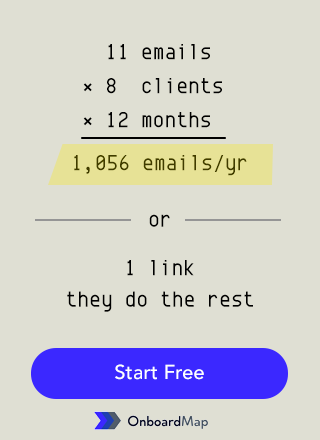
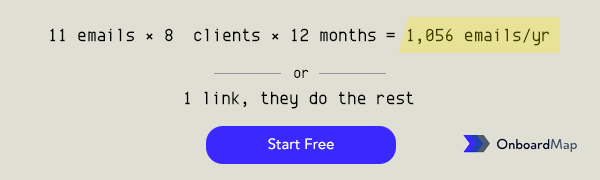
OnboardMap replaces email chaos with one link. Clients complete every step. You see progress instantly.

  • Step-by-step onboarding checklists
  • Document uploads & intake forms
  • Automatic reminders & nudges
No credit card required
Try OnboardMap Free

Recent Case Studies Articles

7/17/2026
Case Studies

Client Onboarding for Mortgage Brokers: Collect Loan Docs Faster

How mortgage brokers can onboard borrowers and collect income, asset, and identity documents in one place without the endless email back-and-forth.
7/17/2026
Case Studies

Client Onboarding for Recruiters and Staffing Agencies

How recruiters and staffing agencies onboard both hiring clients and placed candidates, collecting intake details, agreements, and compliance paperwork in one place.

7/17/2026
Case Studies

Financial Advisor Client Onboarding Checklist (KYC to Funded)

A compliance-ready client onboarding checklist for financial advisors and RIAs, from KYC and risk profiling to account transfers and funded accounts.

7/17/2026
Case Studies

Insurance Client Onboarding: A Step-by-Step Process for Agents

An end-to-end client onboarding process for insurance agents, from quote intake and ACORD applications to binding coverage and delivering the policy.

7/17/2026
Case Studies

Law Firm Client Onboarding Checklist: Conflict Checks to Kickoff

A step-by-step client onboarding checklist for law firms, from conflict checks and engagement letters to secure document collection and matter setup.

7/17/2026
Case Studies

Real Estate Client Onboarding Checklist (Buyers and Sellers)

Separate client onboarding checklists for real estate buyers and sellers, from representation agreements and pre-approval to disclosures and closing documents.

5/4/2026
Case Studies

This Is What Your Bookkeeping Clients Should See on Day One (Live Portal Demo, No Signup)

A live, in-page demo of what a tax-season client onboarding portal looks like for your bookkeeping clients, plus the exact 5-item intake checklist behind it. Click around the demo, no account required.

4/16/2026
Case Studies

Client Onboarding for Real Estate Agents: Turn Signed Agreements Into Closed Deals Faster

Real estate agents do not lose deals at closing. They lose them in the messy first 72 hours after a buyer or seller signs. Here is the onboarding system top producers use to shorten the path from signature to sold.

4/10/2026
Case Studies

Why Marketing Agencies Lose Clients Before the Work Even Starts (And How to Fix It)

Marketing agencies don't lose clients because of bad creative. They lose them in the gap between 'signed' and 'started.' Here's why onboarding is the real retention problem — and how to solve it.

4/9/2026
Case Studies

Client Onboarding for Social Media Managers: The Complete Playbook for 2026

A step-by-step onboarding playbook for social media managers who are tired of chasing logins, brand assets, and content approvals over DMs and email.

3/29/2026
Case Studies

Every Bookkeeper Wastes 10 Hours a Month on Client Intake. Here Is the Fix.

Bookkeepers lose hundreds of hours a year chasing clients for documents. Here is how to automate your entire intake process and get that time back.

3/25/2026
Case Studies

Client Onboarding for Interior Designers and Architects: From Signed Contract to First Concept

A complete onboarding playbook for interior designers and architects who want to collect briefs, budgets, inspiration, and approvals without drowning in email threads.

3/25/2026
Case Studies

Client Onboarding for Therapists and Private Practice: Intake, Compliance, and Building Trust Before Session One

A complete onboarding guide for therapists, counselors, and private practice owners who want to collect intake paperwork, stay HIPAA-compliant, and make clients feel safe before the first session.

3/16/2026
Case Studies

Client Onboarding for Financial Advisors: Compliance, Trust, and the First 30 Days

Financial advisors lose more clients to messy onboarding than to poor returns. Here's the compliance-first framework that fixes both problems.

3/9/2026
Case Studies

Client Onboarding for Life Coaches and Executive Coaches: The Complete Guide

A step-by-step onboarding guide built for life coaches, executive coaches, and leadership coaches who want to start every engagement with clarity, trust, and zero dropped balls.

Show more articles
Client Onboarding for Recruiters and Staffing Agencies
© Photo on Unsplash

Client Onboarding for Recruiters and Staffing Agencies

TLDR: Recruiting is the rare business where you onboard two completely different groups at once. On one side you have the hiring client, the company paying you to fill a role, and they need to hand over job intake details, a signed fee agreement, and a clear picture of their process. On the other side you have the candidate, the person you place, and they need to sign a right to represent, complete an I-9 and W-4, set up direct deposit, and consent to a background check. Miss a step on either side and the placement stalls. This guide walks through both flows so roles get filled faster and nobody falls through the cracks.

Most businesses onboard one type of person. A bookkeeper onboards a client. An IT firm onboards a company. A designer onboards a brand.

Recruiters onboard two.

You onboard the hiring client who signs the contract and pays the fee. And you onboard the candidate who fills the seat. These are two different people, with two different sets of paperwork, two different anxieties, and two different ways things can go wrong. When either side is slow or disorganized, the placement drags, and a dragging placement is a placement your competitor fills first.

Here is how to run both flows cleanly.

Why Recruiting Onboarding Is Two Jobs, Not One

A staffing engagement lives or dies on speed. The client wants the role filled yesterday. The candidate has three other offers in play. Every day of friction between “we agreed to work together” and “the person starts” is a day something can fall apart.

The problem is that recruiters treat onboarding as an afterthought on both sides. The client relationship starts with a handshake and a vague email about the role. The candidate relationship starts with an offer and a scramble to collect paperwork before day one. Neither is structured, so both leak time.

The client flow leaks time because you take the job order over a phone call, forget to ask about the interview process, and end up submitting candidates who get rejected for reasons the client never told you. Then the fee agreement sits unsigned in someone’s inbox while you are already sending resumes.

The candidate flow leaks time because compliance paperwork is boring and easy to defer. The I-9 needs to be verified in person or through an authorized process within a tight window. The background check consent is missing a signature. Direct deposit info arrives the day before payroll runs. Any one of these can push a start date.

Fix both flows and you compress the whole cycle. Let’s start with the client.

The Hiring Client Onboarding Flow

When a company agrees to work with you, the goal of onboarding is to turn a vague “we need a salesperson” into a precise, actionable requisition, and to get the commercial terms locked down before you spend a single hour sourcing.

Step 1: Capture a Real Job Intake

The single biggest cause of wasted recruiting effort is a bad intake. You submit five candidates, the client rejects all five, and only then do you learn they needed someone with a specific certification you were never told about.

A proper intake captures:

  • Role details , title, seniority, department, who the position reports to
  • Must-have vs. nice-to-have skills and qualifications, clearly separated
  • Compensation range, bonus structure, and benefits
  • Location and work model , onsite, hybrid, or remote, and any relocation stance
  • The reason the role is open , growth, backfill, or a problem hire
  • The interview process , how many rounds, who is involved, expected timeline
  • Deal breakers , the things that get a candidate instantly rejected

Do not collect this over a scattered phone call. Send a structured intake form so the hiring manager writes it down. When it is in writing, you have a reference, and you can hold the client to the process they described.

Step 2: Get the Fee Agreement Signed

Nothing else matters until the commercial terms are agreed. Before you source, get a signed agreement covering:

  • Fee structure , contingency percentage, retained flat fee, or contract markup
  • Guarantee period , what happens if the placement leaves in 30, 60, or 90 days
  • Payment terms , net 15, net 30, invoicing triggers
  • Exclusivity, if any, and how long it runs
  • Replacement terms for a failed placement

Chasing a signature after you have already submitted candidates puts you in a weak spot. Lock it first.

Step 3: Confirm the Process and Expectations

The last piece of client onboarding is alignment on how you two will work together. Who is your point of contact. How fast will they give feedback on submitted candidates. How will interviews get scheduled. What is the target timeline to fill.

This is the step recruiters skip, and it is the one that saves the relationship. A client who ghosts you on candidate feedback for a week is not a bad client, they are an un-onboarded client. Set the cadence up front and the whole engagement runs smoother. If you want a deeper look at structuring this side, our guide on onboarding for recruiters breaks the client flow down further.

The Candidate Onboarding Flow

Once you place someone, the second onboarding begins. This one is heavier on compliance, and the stakes are legal, not just commercial. A missing I-9 is not an inconvenience, it is a liability.

Step 1: Right to Represent and Intake

Before you even submit a candidate, you need their permission to represent them for a specific role, so you are not double-submitted and the client relationship stays clean. Collect:

  • Signed right to represent for the specific client and role
  • Current resume and any portfolio or work samples
  • References with contact details and permission to reach out
  • Availability, notice period, and earliest start date
  • Compensation expectations confirmed in writing

Step 2: Compliance and Employment Paperwork

For any candidate you place on your own payroll (contract and temp staffing especially), this is the non-negotiable core:

  • Form I-9 and supporting identity and work authorization documents
  • Form W-4 for federal withholding, plus state equivalents
  • Direct deposit authorization and banking details
  • Emergency contact and personal information
  • Signed offer letter or assignment agreement with pay rate and terms

Every one of these has to be complete and correct before the first shift or the first payroll run. This is where a secure upload portal earns its keep, because banking details and government IDs should never travel over plain email.

Step 3: Screening and Verification Consents

Most placements require some level of screening, and screening cannot start without documented consent. Collect:

  • Background check consent in compliant, standalone form
  • Drug screen consent where the role requires it
  • Credential and certification copies (licenses, clearances, degrees)
  • Employment and education verification authorization
  • Any role-specific compliance , healthcare credentialing, driving records, security clearances

The trap here is timing. Screening takes days, sometimes weeks. If you wait until the offer is signed to kick off a background check, you have added a week to the start date. Front-load the consents during onboarding so the clock starts as early as legally allowed.

The Recruiting Onboarding Checklist

Hiring client side:

  • Structured job intake completed and confirmed in writing
  • Must-have vs. nice-to-have requirements documented
  • Fee agreement signed
  • Guarantee and replacement terms agreed
  • Interview process and timeline confirmed
  • Point of contact and feedback cadence set

Candidate side:

  • Right to represent signed
  • Resume, references, and availability collected
  • Form I-9 completed and verified
  • Form W-4 and state withholding completed
  • Direct deposit authorization received
  • Offer letter or assignment agreement signed
  • Background check consent signed and initiated
  • Drug screen consent collected where required
  • Credentials and certifications verified
  • Start date confirmed with both client and candidate

Run Both Flows From One Place

The reason recruiting onboarding feels chaotic is that both flows usually live in email. The client’s job intake is buried in a thread. The candidate’s I-9 is an attachment you have to scroll to find. You are chasing a signature from a hiring manager and a voided check from a candidate in the same afternoon, on two different platforms, with nothing tracking who owes you what.

Structure fixes this. When each hiring client gets one intake link and each candidate gets one onboarding link, you stop being the human glue holding the process together. You send the link, the system tracks every step, it reads the uploaded documents, and it sends the reminders you would otherwise be sending by hand at 9 PM.

OnboardMap lets you describe an onboarding in one sentence and builds the whole thing for you, the checklist, the intake forms, the document requests, and a branded portal. Set up one flow for hiring clients and one for candidates, then reuse them for every new engagement. You send a single link, it tracks progress, reads the uploads, and nudges people who go quiet, so you can spend your time filling roles instead of shuffling paperwork.

The recruiters who fill roles fastest are not working more hours. They built two clean onboarding flows once and reuse them for every client and every placement. See how OnboardMap handles onboarding for recruiters and staffing agencies and start turning signed agreements into filled seats faster.

Ready to fix your onboarding?

Send one link. Clients upload docs, fill intake forms, and complete every step — automatically tracked. No account required for your clients.

First onboarding free. No credit card required.

Related articles

Client Onboarding for Mortgage Brokers: Collect Loan Docs Faster

7/17/2026

How mortgage brokers can onboard borrowers and collect income, asset, and identity documents in one place without the endless email back-and-forth.

Employee Onboarding Process: A Step-by-Step Guide for Small Teams

7/17/2026

A repeatable employee onboarding process for small teams and HR, from offer acceptance through new-hire paperwork to a productive first week.

Financial Advisor Client Onboarding Checklist (KYC to Funded)

7/17/2026

A compliance-ready client onboarding checklist for financial advisors and RIAs, from KYC and risk profiling to account transfers and funded accounts.

Austin Spaeth

Austin Spaeth is the founder of OnboardMap, a client onboarding portal for service businesses. After years of watching agencies and consultancies lose time to scattered onboarding processes, he built OnboardMap to give every client a single link with everything they need to get started.

OnboardMap

Onboard clients in one sentence. Describe what you need and OnboardMap builds the whole onboarding, checklist, forms, and document requests, then sends one link and tracks every step for you.

Start For Free