Try OnboardMap Free

Start Here

Whether you're onboarding new clients, collecting documents, or building intake forms, we'll help you get organized.

Stop Chasing Clients

OnboardMap replaces email chaos with one link. Clients complete every step. You see progress instantly.

  • ✓ Step-by-step onboarding checklists
  • ✓ Document uploads & intake forms
  • ✓ Automatic reminders & nudges
No credit card required
Try OnboardMap Free

Recent Onboarding Articles

10/3/2026
Onboarding

ClickUp Client Onboarding Template: A Free Build (and When to Outgrow It)

A step-by-step guide to building a client onboarding template in ClickUp, with the exact Space and List structure, custom statuses, automations, and the honest limits that tell you when to switch to purpose-built software.

10/2/2026
Onboarding

The Endowed Progress Effect: Why Starting Clients at Zero Percent Stalls Onboarding

A new client who sees an empty progress bar feels like they are starting from scratch, and starting is the hardest part. The endowed progress effect shows why giving clients a head start on onboarding makes far more of them finish.

10/1/2026
Onboarding

How to Onboard Inherited Clients: Keep the Book of Business You Just Acquired

Buying a practice or taking over a book of business means inheriting clients who never chose you. Here is a re-onboarding playbook that re-earns trust fast, fixes the records you inherited, and keeps the clients you paid for from quietly leaving.

9/30/2026
Onboarding

How to Use ChatGPT for Client Onboarding (Prompts + Workflow)

ChatGPT can cut your client onboarding prep from hours to minutes if you use it for the right tasks. Here are copy-paste prompts for checklists, intake forms, and welcome emails, plus where AI stops and software takes over.

9/28/2026
Onboarding

Client Onboarding in Slack: How to Run Client Channels Without the Chaos

Slack Connect makes client onboarding feel fast and friendly, right up until requests scroll away and nobody knows what is still outstanding. Here is how to run client channels that stay organized, plus where a chat tool should hand off to a real onboarding surface.

9/27/2026
Onboarding

HoneyBook vs Dubsado for Client Onboarding: Which One Fits Your Service Business?

HoneyBook and Dubsado both promise to run your client onboarding, but they solve it differently. Here is an honest comparison for the onboarding part specifically, plus the signs you have outgrown an all-in-one CRM and need a purpose-built onboarding tool.

9/26/2026
Onboarding

Client Onboarding Compliance: The Consent, Verification, and Data Checklist

Onboarding is the moment you collect the most sensitive client data you will ever hold: IDs, financials, logins, signed agreements. That makes it the moment your compliance obligations are highest. Here is a practical client onboarding compliance checklist built around consent, verification, data minimization, secure handling, retention, and an audit trail.

9/25/2026
Onboarding

The IKEA Effect in Client Onboarding: Why Clients Value the Setup They Help Build

Doing all the setup for a new client feels like great service, but it quietly costs you loyalty. The IKEA effect shows why clients value the onboarding they help build, and how to put them in the builder's seat without adding friction.

9/24/2026
Onboarding

Client Offboarding: The Checklist That Protects Your Data, Reputation, and Referrals

Most service businesses have an onboarding process and nothing at the other end. A deliberate client offboarding process protects your data, closes out access cleanly, and turns a departing client into a referral source. Here is the full checklist.

9/23/2026
Onboarding

Client Onboarding E-Signatures: Get Contracts Signed Without Stalling the Whole Process

The signature is where onboarding quietly stalls. A contract sits unsigned for a week, and everything downstream waits with it. Here is how to collect e-signatures as part of onboarding so nothing gets stuck at the signing step.

9/22/2026
Onboarding

Productized Service Onboarding: The Repeatable System Your Offer Actually Needs

A productized service promises the same result at the same price every time. If your onboarding is still custom for every client, you do not really have a productized service. Here is how to build onboarding that runs like the rest of your offer: once, the same way, at scale.

9/21/2026
Onboarding

The Onboarding Handoff: How to Move a Client From Setup to Real Work Without Dropping the Ball

Everyone talks about the sales-to-onboarding handoff. Almost nobody plans the second one: moving a client from setup into ongoing delivery. That seam is where good onboarding quietly falls apart. Here is how to close it.

9/20/2026
Onboarding

How to Collect a Deposit Before Client Work Starts (Without the Awkward Money Talk)

If you start work before the deposit clears, you are financing your client's project. Here is how to make paying the deposit a normal, tracked step in your onboarding, so you get paid up front without the awkward money conversation.

9/18/2026
Onboarding

How to Onboard Non-Technical Clients Without the Tech-Support Headaches

Some of your best clients are your least tech-savvy ones. This guide shows how to onboard non-technical clients without becoming their unpaid help desk: remove logins, cut steps, and let the tool do the chasing.

9/17/2026
Documents

Google Drive vs. a Client Portal for Collecting Client Documents

A shared Google Drive or Dropbox folder feels like the obvious way to collect documents from clients. This guide compares it to a purpose-built client portal on security, tracking, reminders, and client friction, and shows when each one is the right call.

Show more articles
Secure File Upload for Client Onboarding: What to Look For
© Photo by Franck on Unsplash

Secure File Upload for Client Onboarding: What to Look For

TLDR: When choosing a secure file upload tool for client onboarding, demand encryption in transit and at rest, role-based access controls, audit trails, and retention policies as non-negotiables. But security alone is not enough — if the tool is harder to use than email, your clients will just email you the files anyway.

Your clients are sending you Social Security numbers, bank statements, tax returns, contracts, and government-issued IDs. If those files are traveling through unencrypted email or sitting in a shared Google Drive folder with loose permissions, you have a problem.

It is not a hypothetical problem, either. A single data breach can cost a small firm $120,000 to $1.24 million in remediation, legal fees, and lost clients. And “we used email” is not a defense regulators will accept.

You need a secure file upload solution. But not all of them are worth your money.

The Non-Negotiable Security Features

When evaluating any file upload tool for client onboarding, these five features are baseline requirements. If a tool is missing any of them, move on.

1. Encryption in Transit (TLS/SSL)

Every file your client uploads should be encrypted the moment it leaves their browser. This means the connection between their device and the server uses TLS 1.2 or higher. Look for HTTPS across the entire application — not just the login page.

This prevents anyone from intercepting files while they are being uploaded. It is the equivalent of a sealed envelope versus a postcard.

2. Encryption at Rest (AES-256)

Once files land on the server, they should stay encrypted. The industry standard is AES-256 encryption, the same standard used by banks and government agencies. This means that even if someone gains unauthorized access to the server’s storage, the files are unreadable without the encryption keys.

Ask the vendor directly: “Are files encrypted at rest, and what encryption standard do you use?” If they cannot give you a clear answer, that tells you everything.

3. Access Controls

Not everyone on your team needs access to every client’s documents. A proper file upload system lets you set role-based permissions:

  • Admin access — Full visibility and management across all clients
  • Team member access — Only the clients they are assigned to
  • Client access — Only their own uploaded documents

This is especially important for firms with multiple staff members handling different client accounts. The bookkeeper working on Client A should not be able to browse Client B’s tax returns.

4. Audit Trails

You need a record of who uploaded what, when they uploaded it, and who accessed it afterward. This is not just good practice — it is a compliance requirement for many regulated industries.

An audit trail should log:

  • File upload timestamps
  • User identity for each action
  • File downloads and views
  • Any deletions or modifications

If a client ever disputes whether they submitted a document, or a regulator asks how you handled sensitive data, the audit trail is your proof.

5. Automatic File Expiration and Retention Policies

You should not be storing client documents indefinitely without a policy. Look for tools that let you set retention periods — for example, automatically deleting uploaded files 90 days after a project closes. This reduces your liability surface and keeps you aligned with data minimization principles.

Security Features That Are Nice to Have

Beyond the basics, these features separate good tools from great ones:

  • Two-factor authentication (2FA) for both your team and clients
  • IP whitelisting to restrict access from specific locations
  • Watermarking on downloaded documents to trace leaks
  • Virus and malware scanning on uploaded files before they reach your storage
  • SOC 2 Type II compliance — an independent audit of the vendor’s security practices

The Usability Problem

Here is where most secure file upload tools fail: they are painful to use.

Bank-grade security means nothing if your client cannot figure out how to upload a PDF. The best secure upload tool in the world is useless if clients give up halfway through and just email you the file anyway.

When evaluating usability, test the client experience yourself:

  • Can a non-technical person complete an upload in under 2 minutes? Time yourself going through the flow as if you were a client.
  • Does it work on mobile? Many clients will upload documents from their phone using photos of physical documents.
  • Is the interface clean and intuitive? If there are more than 3 steps between opening the link and completing an upload, it is too complicated.
  • Are file type and size limits reasonable? Clients should be able to upload PDFs, images, and common document formats without hitting arbitrary walls.

The tools that replace email for document collection need to be easier than email, not harder. Otherwise, clients will default back to their inbox.

What About Generic File Sharing Tools?

Dropbox, Google Drive, and OneDrive are fine for internal file sharing. They are not built for client document management during onboarding.

Here is why:

  • No structured requests. You cannot give a client a checklist of specific documents to upload. They just see a folder.
  • No progress tracking. You have no way to see which required documents are still missing.
  • Confusing client experience. Clients need a Google or Dropbox account, or they get confused by shared link permissions.
  • No onboarding workflow. File sharing tools handle files. They do not handle the process around those files.

A purpose-built client onboarding portal combines secure file uploads with structured workflows, progress tracking, and communication — all in one place.

Questions to Ask Before You Buy

Before committing to a secure file upload tool, ask these questions:

  1. Where are files stored, and in which geographic region?
  2. What happens to files if I cancel my subscription?
  3. Do you have a SOC 2 report or equivalent security certification?
  4. Can clients upload without creating an account?
  5. What is your incident response process for a data breach?
  6. Do you support single sign-on (SSO) for my team?

The answers will tell you whether the vendor takes security seriously or just checks boxes on a marketing page.

Secure Uploads Without the Complexity

OnboardMap provides encrypted file uploads, role-based access controls, and full audit trails — wrapped in a client experience so simple that your least tech-savvy client can complete it on their phone. No accounts to create. No folders to navigate. Just a clear list of what to upload and a drag-and-drop interface.

Get early access to OnboardMap and give your clients a secure, simple way to send you their documents.
Ready to fix your onboarding?

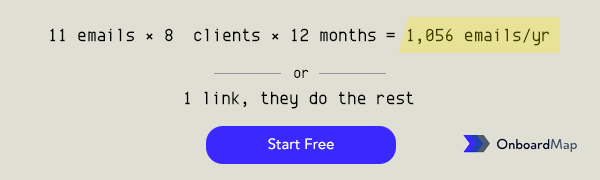
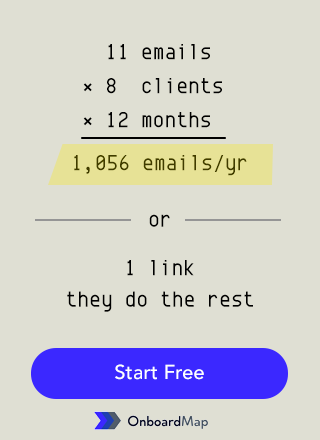
Send one link. Clients upload docs, fill intake forms, and complete every step — automatically tracked. No account required for your clients.

First onboarding free. No credit card required.

Related articles

Client Document Management During Onboarding: Keep Everything Organized

2/13/2026

Disorganized client documents slow down onboarding and create mistakes. Here is how to keep everything organized from day one.

Client Onboarding E-Signatures: Get Contracts Signed Without Stalling the Whole Process

9/23/2026

The signature is where onboarding quietly stalls. A contract sits unsigned for a week, and everything downstream waits with it. Here is how to collect e-signatures as part of onboarding so nothing gets stuck at the signing step.

Google Drive vs. a Client Portal for Collecting Client Documents

9/17/2026

A shared Google Drive or Dropbox folder feels like the obvious way to collect documents from clients. This guide compares it to a purpose-built client portal on security, tracking, reminders, and client friction, and shows when each one is the right call.

Austin Spaeth

Austin Spaeth is the founder of OnboardMap, a client onboarding portal for service businesses. After years of watching agencies and consultancies lose time to scattered onboarding processes, he built OnboardMap to give every client a single link with everything they need to get started.

OnboardMap

Onboard clients in one sentence. Describe what you need and OnboardMap builds the whole onboarding, checklist, forms, and document requests, then sends one link and tracks every step for you.

Start For Free