TLDR: A client onboarding email subject line has one job: get the email opened and tell the reader what to do. Keep it under about 45 characters, name the single action (“upload your documents,” “book the call,” “log in to your portal”), put the most important word first, and never bury a deadline. The 30 examples below are grouped by onboarding stage and ready to copy.
You wrote a good onboarding email. Warm opening, clear steps, a friendly sign-off. You hit send, feel organized for once, and move on.
Three days later the client has done nothing. You follow up. “Oh, sorry, I must have missed that one.”
They did miss it. Not because they are careless, but because your subject line gave them no reason to open it. It was sitting in a phone inbox next to a shipping notice, a calendar invite, and forty newsletters, and it said something like “Welcome and next steps.” Nothing in that line told them the email needed anything from them today. So it waited. And your project waited with it.
This is the quiet tax on every service business that runs onboarding through email. The client onboarding email subject line is the cheapest lever you have, and most people never touch it. Fix it and you get more opens, faster document turnaround, and fewer “did you get my last email?” replies clogging your week.
Why the subject line decides whether onboarding moves
Onboarding emails are not marketing emails. When a client just signed with you, they are paying attention and they want to open your messages. That works in your favor, and it is also easy to waste.
Transactional and onboarding emails tend to see much higher open rates than newsletters, often in the 40 to 60 percent range versus the 20 to 30 percent typical of a promotional blast. But that number collapses the moment your subject lines all look the same. If every email you send says “Following up” or “Checking in,” the client cannot tell the urgent one from the routine one. So they triage by opening none of them and telling themselves they will get to it later.
The other pressure is the phone. More than half of business email now gets read on mobile first, and mobile mail apps show only the first 35 to 45 characters of a subject line before cutting it off. A subject like “A quick note about a few documents we are going to need from you” becomes “A quick note about a few docum…” on a phone. The reader sees vague throat-clearing and swipes past.
Specific subject lines that name an action consistently outperform generic ones. The gap between "Upload 3 files" and "Welcome and next steps" is the difference between a project that starts on time and one that stalls.
The three rules behind every subject line that works
Before the examples, the pattern. Every good onboarding subject line follows the same three rules, and once you see them you can write your own.
Name the action, not the topic. “Documents” is a topic. “Upload your 3 documents” is an action. The reader should know what the email wants before they open it. This alone fixes most low open rates.
Front-load the important word. Whatever gets truncated on a phone should be the least important part. Put the deadline, the number, or the verb at the start. “Due Friday: your intake form” survives truncation. “Just a friendly reminder that your intake form is due Friday” does not.
One email, one ask. A subject line that promises one clear thing gets opened and acted on. A subject line that hedges (“welcome, some documents, and scheduling”) signals a wall of homework and gets postponed.
Length is the guardrail around all three: under about 45 characters, roughly 5 to 8 words. If you cannot say it in that space, your email is probably trying to do two jobs and should be two emails.
30 client onboarding email subject lines by stage
Here are 30 subject lines grouped by the stage of onboarding they belong to. Copy them, swap in your specifics, and keep the structure. Brackets mark what to personalize.
Stage 1: The welcome (send within an hour of signing)
The welcome sets the tone. Warm is fine, but still name what happens next so it does not read as filler.
Subject line
Why it works
We’re glad you’re here, [First Name]
Personal, human, low friction to open
You’re all set. Here’s step 1
Signals momentum, promises one action
Welcome to [Company] (2-minute setup)
Sets a small, honest time expectation
Next: 3 quick things to get started
Numbered and finite, not open-ended
Your onboarding starts now, [First Name]
Active, names the reader, implies motion
Stage 2: The portal invite or account access
This is a transactional email. Skip the personalization tricks and be plain. People open access emails because they need the thing inside.
Subject line
Why it works
Your [Company] portal is ready
Clear, expected, nothing to decode
Log in to see your onboarding checklist
Tells them exactly what is inside
Your secure link to upload documents
Leads with “secure,” a reassurance word
One link, no password needed
Removes the biggest reason people stall
Access your client portal (bookmark this)
Practical instruction, builds a habit
Stage 3: The document or information request
The most-ignored email in onboarding, so it needs the sharpest subject line. Numbers and time estimates do the heavy lifting.
Subject line
Why it works
Your 3 documents to upload (5 min)
Number plus time estimate lowers dread
Quick: we need your [W-9] to start
Names the specific item and the stakes
Upload your files here (takes 5 minutes)
Honest effort estimate, single action
2 forms left before we can begin
Progress framing, finite finish line
[First Name], your intake form (last step)
Personal, positions it as almost done
Stage 4: The nudge (client has gone quiet)
Do not send another “checking in.” Reference the specific thing and, if it fits, use their name. This is where personalization earns its place.
Subject line
Why it works
Still need your [W-9], [First Name]
Specific item, personal, no guilt trip
Your project is waiting on 1 file
Reframes the delay around their goal
Reminder: intake form due [Friday]
Front-loaded deadline, survives truncation
5 minutes stands between you and [outcome]
Ties the task to the reward
Did the upload link work for you?
Assumes goodwill, opens a low-stakes reply
Stage 5: The kickoff and confirmation
Momentum stage. Confirm, schedule, and make the next step feel like a reward for finishing the boring parts.
Subject line
Why it works
You’re all set. Let’s book your kickoff
Rewards completion, prompts scheduling
Book your kickoff call (2 times this week)
Offers choice, reduces back-and-forth
Everything’s in. Here’s what happens next
Confirmation plus forward motion
We start [Monday]. Here’s the plan
Concrete date, sets expectations
Your onboarding is done. Nice work
Positive close, marks a clear finish
Notice what almost none of these say: your company name at the front, “just,” “quick note,” or “circling back.” Those words fill space without telling the reader anything. Cut them.
Subject line mistakes that quietly kill your open rate
Most bad onboarding subject lines are not offensive. They are just invisible. Watch for these.
Leading with your company name. ”[Company]: onboarding information” wastes the first and most valuable characters on a word the client already knows. Your name is in the sender field. Use the subject line for the action.
Vague verbs. “Following up,” “checking in,” and “circling back” describe your behavior, not the client’s task. Say what you need.
Burying the deadline. If something is due Friday, “Friday” belongs at the front, not in sentence 3 of a subject line nobody reads to the end.
Fake urgency. “URGENT” and “ACTION REQUIRED” in all caps train clients to distrust you. Real specificity (“2 forms left before we can begin”) creates urgency without shouting.
Overusing the first name. A name on every email becomes a mail-merge tell. Reserve it for the welcome and the genuine nudge, where a human touch matters.
Cramming two asks into one line. “Welcome, upload your docs, and book a call” reads as homework. Split it. One email, one ask.
How to test your subject lines without a marketing team
You do not need software to improve. You need to pay attention on purpose.
Pick one email to fix first. The document request is almost always the highest-leverage one because it is the most ignored and the most blocking. Start there.
Write two versions. Keep the body identical. Change only the subject line: one specific and action-named, one the way you write it now.
Alternate by client. Odd-numbered new clients get version A, even-numbered get version B. Low tech, good enough.
Track opens or, better, the outcome. If your email tool shows opens, use them. If not, track the real thing that matters: how many days until the documents actually arrive.
Keep the winner, retire the loser. After ten clients you will see a pattern. Standardize the winner so you never write it from scratch again.
The point is not to become an email marketer. It is to notice that a five-word change on a subject line moves your document turnaround by days, and to bank that win permanently.
The bigger point: the best onboarding email is the one you never send
Here is the uncomfortable truth under all of this. You are optimizing subject lines because your onboarding lives in your inbox, and an inbox is a terrible project manager. Emails get buried. Reminders depend on you remembering to send them. Nothing shows the client what is done and what is left.
Every subject line in this article is a workaround for a system you do not have. The document request, the nudge, the “still waiting on your W-9,” the third follow-up: those exist because there is no shared place that tracks the client’s progress and chases them without you.
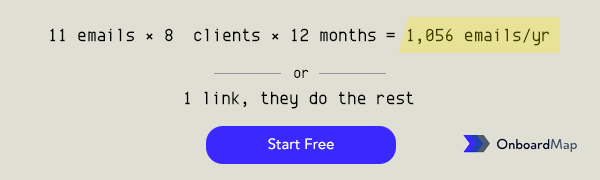
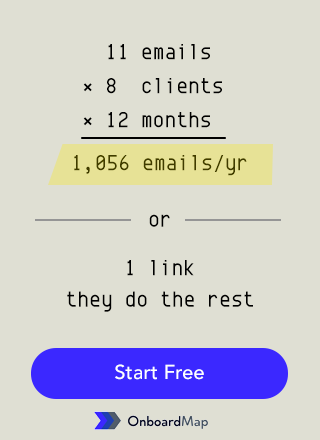
That is the case for a client portal. Purpose-built tools like OnboardMap replace the email chase with one magic link per client (no login, no password), an onboarding checklist the client can see, secure document upload that keeps files out of email, and automated reminders that fire on their own schedule. You describe what you need in a sentence and it builds the checklist, intake forms, and document requests for you. The client sees exactly what is left; the system sends the nudges. You stop writing “quick reminder” emails because the software already sent one, at the right time, with the right subject line built in.
You will still send a warm welcome and a kickoff confirmation, and now you have great subject lines for those. But the three logistics emails that eat your week (portal invite, document request, deadline reminder) become things the system handles. For the fuller argument, see replacing email with an onboarding portal and how to automate client onboarding reminders. If you want the full email set to pair with these subject lines, the 5-email onboarding sequence templates give you the bodies to match.
Ready to send fewer onboarding emails and chase fewer documents? Start free at app.onboardmap.com/signup and let the portal handle the reminders you have been writing by hand.
Frequently asked questions
What makes a good client onboarding email subject line? Three things: length, specificity, and a clear action. Keep it under about 45 characters, name the exact next step instead of a vague greeting, and put the most important word first. “Your 3 documents to upload (5 min)” beats “Welcome and next steps” because the reader knows what the email wants before they open it.
How long should an onboarding email subject line be? Aim for 30 to 45 characters, or roughly 5 to 8 words. Most mobile mail apps truncate somewhere between 35 and 45 characters, and most business email is read on a phone first, so front-load the meaning.
Should I use the client’s name in the onboarding subject line? Sometimes. A first name can lift opens on a personal welcome or a nudge to someone who has gone quiet. Skip it on transactional emails like a portal login link, where it reads as a mail-merge tell. Personalize the reason for the email, not just the greeting.
Why do my onboarding emails get ignored? Usually because the subject line hides the ask. If every email says “Following up,” the client cannot tell the urgent one from the routine one. The deeper fix is to stop relying on email for logistics: a portal that shows an open checklist and sends its own reminders removes most of the emails that get ignored.
How many onboarding emails should I send a new client? Fewer than you think. A tight sequence is five: welcome, portal or document request, check-in, deadline reminder, and kickoff confirmation. If you are sending eight or ten, your process lives in your inbox. Move document collection and reminders into a portal and the count drops on its own.
Ready to fix your onboarding?
Send one link. Clients upload docs, fill intake forms, and complete every step — automatically tracked. No account required for your clients.
Austin Spaeth is the founder of OnboardMap, a client onboarding portal for service businesses. After years of watching agencies and consultancies lose time to scattered onboarding processes, he built OnboardMap to give every client a single link with everything they need to get started.
OnboardMap
Onboard clients in one sentence. Describe what you need and OnboardMap builds the whole onboarding, checklist, forms, and document requests, then sends one link and tracks every step for you.