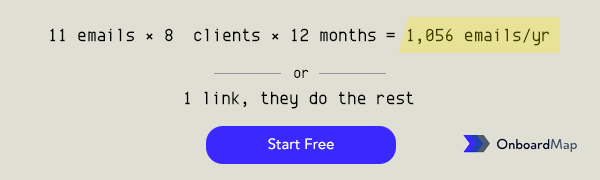
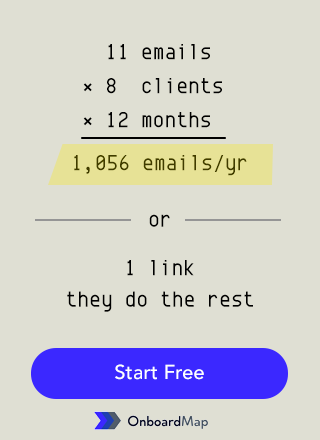
TLDR: A client onboarding portal replaces the chaos of five emails, three follow-ups, and a lost attachment with a single link where clients complete every onboarding task — forms, uploads, signatures — in one place. It gives clients clarity on what to do and gives your team real-time visibility into progress.
Picture this. A new client signs on with your agency. Over the next two weeks, you send them:
- A welcome email with next steps
- A follow-up with an intake questionnaire link
- Another email asking for their logo files
- A separate email requesting signed tax forms
- Two reminder emails because they forgot the tax forms
- A Slack message asking if they got the last email
Your client, meanwhile, is drowning in messages from you and has no idea what they have completed and what is still outstanding.
A client onboarding portal eliminates all of that.
What a Client Onboarding Portal Actually Is
A client onboarding portal is a single, dedicated page (or set of pages) where a new client can see and complete every onboarding task. Intake forms, document uploads, agreement signatures, project details — everything lives in one place.
Instead of sending five emails with five different links, you send one link. The client opens it and sees a clear list of what they need to do. They complete items at their own pace. You track their progress from your dashboard.
That is it. No app downloads. No account creation. No guessing.
How It Works in Practice
Here is what the experience looks like from your client’s perspective:
- They receive a single link after signing their contract.
- They click it and see their onboarding portal — branded with your logo and colors.
- The portal shows a checklist: fill out this form, upload these documents, review this agreement.
- They complete items in any order. Progress is saved automatically.
- If they miss something, they get a gentle reminder with a link back to the same portal.
- When everything is done, they see a confirmation and know exactly what happens next.
From your side, you see a dashboard showing every client, what they have completed, and what is still pending. No digging through email. No wondering where things stand.
Why Portals Beat Email for Onboarding
Email was not designed for onboarding. It was designed for conversations. Using email to manage a multi-step process with document collection, forms, and deadlines is like using a hammer to turn a screw. You can make it work, but it is the wrong tool.
Here is where portals win:
Everything in One Place
With email, your client’s onboarding is scattered across fifteen messages. With a portal, it is all on one page. Clients know exactly where to go and what to do. You can read a detailed comparison of client portals vs. email-based onboarding to see the full breakdown.
Clear Progress Tracking
Portals show completion status — both to you and to the client. Your client can see they have finished three of five items. You can see that across all your active clients, twelve items are still outstanding. That kind of visibility is impossible with email.
Fewer Reminders Needed
When clients have a clear, visual checklist, they are more likely to complete items without being reminded. And when reminders are needed, automated nudges from the portal are less intrusive than another email from you personally.
Professional First Impression
A branded portal says “we have a system.” A chain of emails says “we are figuring this out as we go.” For a deeper look at setting up your own branded experience, check out our guide on how to set up a branded client portal.
Documents Stay Organized
Files uploaded through a portal are attached to the right client, in the right place, every time. No more searching your inbox for “that PDF Sarah sent three weeks ago.”
What a Good Onboarding Portal Includes
Not all portals are created equal. Here are the features that actually matter for onboarding:
- Custom intake forms. You should be able to build forms that match your specific onboarding questions — not just generic contact fields.
- Secure document uploads. Clients need a way to upload files directly. Tax documents, contracts, brand assets, ID verification — whatever your business requires.
- Task checklists. A clear list of everything the client needs to complete, with status indicators for each item.
- Automated reminders. The portal should follow up on incomplete items without you having to do it manually.
- Branding. Your logo, your colors, your domain. The portal should look like an extension of your business, not a third-party tool.
- No client login required. This is critical. If your client has to create a username and password just to complete onboarding, you have added friction. The best portals use secure links instead.
Who Needs an Onboarding Portal
If you onboard more than a couple of clients per month, you need a portal. Period.
But some businesses benefit more than others:
- Accounting firms collecting tax documents, financial statements, and signed engagement letters from dozens of clients every quarter.
- Marketing agencies gathering brand guidelines, access credentials, content assets, and campaign briefs from each new client.
- Law firms requesting signed retainers, identification documents, case-related paperwork, and detailed intake questionnaires.
- Consultancies collecting background information, stakeholder details, and project scoping documents before an engagement begins.
- Financial advisors onboarding clients with compliance paperwork, account transfer forms, and risk assessments.
In every case, the pattern is the same: multiple items from the client, collected over days or weeks, that need to be organized and tracked.
The Difference Between an Onboarding Portal and a Project Management Tool
This is a common point of confusion. Tools like Asana, Monday.com, and Basecamp have client-facing features. But they are project management tools first. The client experience is an afterthought.
An onboarding portal is designed for the client’s experience from the ground up. It is not a dashboard full of tasks and timelines. It is a simple, guided process that tells the client: here is what we need, here is how to give it to us, here is where you stand.
If you are curious about how this fits into the broader landscape of client onboarding software, we break that down separately.
Getting Started with a Portal
You can start small. Pick the three to five items you collect from every new client and put them into a portal. An intake form, a document upload request, and a welcome message is enough to start.
Once you see how much smoother it is — for you and for your clients — you will wonder why you ever did it any other way.
OnboardMap gives you a branded client onboarding portal with intake forms, document collection, automated reminders, and zero client logins required. It is built for service businesses that want to look professional and move fast.
Get early access to OnboardMap and launch your onboarding portal this week.