3/29/2026
Case Studies
Every Bookkeeper Wastes 10 Hours a Month on Client Intake. Here Is the Fix.
Bookkeepers lose hundreds of hours a year chasing clients for documents. Here is how to automate your entire intake process and get that time back.
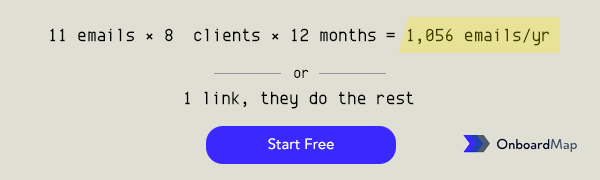
Whether you're onboarding new clients, collecting documents, or building intake forms, we'll help you get organized.
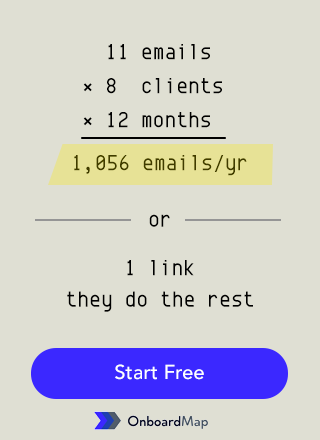
OnboardMap replaces email chaos with one link. Clients complete every step. You see progress instantly.

TLDR: If you are a consultant or coach who skips formal onboarding because your work “feels too personal” for process, you are setting yourself up for scope creep, miscommunication, and clients who ghost. Build a repeatable onboarding system — intake questionnaire, written expectations, structured first session — and you will retain more clients with less effort.
You had a great discovery call. The client is excited. You’re excited. They pay the invoice and you’re officially working together.
Then what?
For most independent consultants and coaches, the answer is: “I’ll send them a calendar link and we’ll figure it out.” And for a while, that works. Until you’re three weeks in and the client isn’t clear on what they’re getting. Or you realize you’re solving a completely different problem than what you scoped. Or the client ghosts on homework between sessions.
Onboarding is the thing that separates consultants who retain clients from consultants who constantly replace them.
There’s a common belief in consulting and coaching that onboarding is for “bigger” businesses. You’re one person. The engagement is personal. Why formalize it?
Here’s why:
Before your first working session, you need to understand the client’s situation deeply. A discovery call scratches the surface. An intake questionnaire with 50+ targeted questions gets you the full picture.
For consultants, your intake should cover:
For coaches, adjust toward:
Don’t ask these questions live. Send the questionnaire in advance so clients can give thoughtful, complete answers. Then use the first session to dig deeper into what they wrote.
After the intake, send a welcome document that covers:
This is not about being rigid. It’s about preventing the conversations you don’t want to have later. When a client asks “can I text you at 9 PM on a Saturday?” you can point to the welcome document instead of having an awkward boundary conversation.
Depending on your practice, you may need documents or materials from the client before you can begin. Don’t collect these piecemeal.
Build a simple intake form that captures everything in one pass:
The key is one form, one submission, everything in one place. Not five emails over two weeks.
Your first working session should follow a clear format:
End the session by summarizing everything in writing. Send it within 24 hours.
The biggest risk in consulting and coaching engagements isn’t that the advice is wrong. It’s that nothing gets implemented.
Build accountability into your onboarding:
This works best for small teams and solo practitioners who need lightweight systems that don’t add overhead.
When you onboard well, clients get results faster. When clients get results faster, they stay longer. When they stay longer, they refer others.
One well-onboarded client is worth more than three poorly onboarded ones. The math isn’t complicated.
OnboardMap helps consultants and coaches collect intake information, set expectations, and track client progress — all from a single, organized workspace.
Get early access and give every client engagement the start it deserves.
Send one link. Clients upload docs, fill intake forms, and complete every step — automatically tracked. No account required for your clients.
Austin Spaeth is the founder of OnboardMap, a client onboarding portal for service businesses. After years of watching agencies and consultancies lose time to scattered onboarding processes, he built OnboardMap to give every client a single link with everything they need to get started.
Client onboarding portal that replaces email chaos. Send one link. Clients upload everything, complete every step, and you see progress instantly.
Start For FreeFree plan includes 3 onboardings/mo.