3/24/2026
Onboarding
How to Onboard 50 Clients This Quarter Without Losing Your Mind
A tactical playbook for bookkeepers, accountants, and service teams scaling past 10 clients a month — without hiring or burning out.
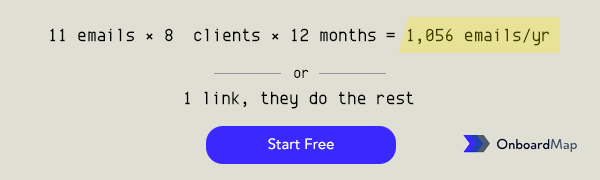
Whether you're onboarding new clients, collecting documents, or building intake forms, we'll help you get organized.
OnboardMap replaces email chaos with one link. Clients complete every step. You see progress instantly.
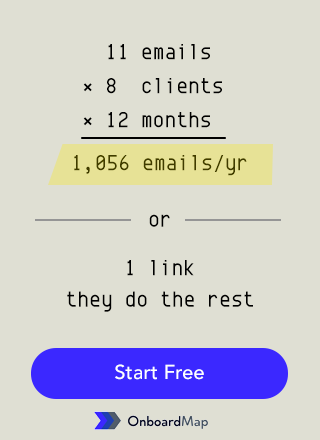
TLDR: Below are seven copy-and-paste follow-up email templates that escalate from friendly nudge to final notice — but the real takeaway is that chasing clients for documents is a systems problem, not a writing problem. An automated client portal with built-in reminders eliminates 80% of follow-ups entirely.
You just signed a new client. The proposal is accepted. The invoice is paid. Everyone is excited to get started.
And then… silence.
You send the welcome email with a list of documents you need. Nothing. You follow up three days later. Crickets. A week goes by and you send another email, this time with a slightly more desperate subject line. Still nothing. Now you are two weeks into what should have been a straightforward onboarding, and you have not received a single document.
Sound familiar? You are not alone. If you run a bookkeeping firm, marketing agency, MSP, or consulting practice, you have lived this exact scenario dozens, maybe hundreds, of times. Chasing clients for documents is the most soul-crushing, time-wasting part of running a service business, and it never seems to get better no matter how many clients you take on.
In fact, it gets worse. The more clients you have, the more follow-up emails you are writing, the more threads you are tracking, and the more things slip through the cracks. One bookkeeper we spoke with estimated she spends seven hours per week just sending follow-up emails to clients who have not submitted their documents. Seven hours. That is almost an entire workday, every single week, doing work that generates zero revenue.
This article gives you two things. First, seven battle-tested follow-up email templates you can copy, paste, and send today. They work. They are specific to common scenarios and written to actually get responses. Second, and more importantly, we are going to show you why these templates are band-aids on a broken process, and what the actual fix looks like.
Before we get to the templates, let us talk about what this problem is actually costing you. Because it is not just your time.
It is costing you money. Every hour you spend writing follow-up emails is an hour you are not spending on billable work, business development, or strategic thinking. At even a modest effective rate of $150/hour, seven hours of weekly follow-ups costs you over $54,000 per year in lost productivity.
It is costing you client relationships. Nobody likes being nagged. Every follow-up email you send chips away at the goodwill you built during the sales process. Your new client signed up because they were excited to work with you, and now the first thing they experience is a barrage of “just checking in” emails. That is not the first impression you want to make. We wrote extensively about this in our guide on why a client portal beats email for onboarding.
It is costing you your sanity. There is a special kind of frustration that comes from doing the same unproductive task over and over again, knowing it should not be this hard. You did not start your business to become a professional email chaser.
It is costing you capacity. When onboarding drags on for weeks because clients are not sending documents, you cannot start the actual work. Projects stack up. Timelines slip. You either have to delay new client intake or risk overloading your team when everything finally arrives at once.
The average service business loses 3-4 weeks on every new client engagement just waiting for documents. Multiply that across 10, 20, or 50 clients per year and you are looking at months of wasted time.
Now, let us give you some templates that can help in the short term.
When to use it: Your client has not responded to your initial document request. It has been about three days. You want to stay warm and helpful without applying pressure.
Subject: Quick reminder - documents needed to kick off your [project/engagement]
Hi [Client Name],
Hope your week is going well! I wanted to follow up on the document list I sent over on [date]. I know things get busy, so I just wanted to make sure it did not get buried in your inbox.
To get started on [specific deliverable or service], we need the following:
- [Document 1]
- [Document 2]
- [Document 3]
If you have questions about any of these items or are not sure where to find something, just reply to this email and I am happy to walk you through it.
Looking forward to getting started!
Best, [Your Name]
Why it works: It is specific about what you need, offers help, and ties the request back to something the client cares about (getting their project started). It does not guilt-trip or pressure.
When to use it: A full week has passed. The client may be confused about what you need, where to find it, or how to send it. This email removes friction.
Subject: Need help finding those documents? Here is a quick guide
Hi [Client Name],
I know gathering documents can feel like a chore, so I wanted to make this as easy as possible for you. Here is a quick breakdown of exactly what we need and where you can typically find each item:
[Document 1] - You can usually find this in [specific location, e.g., “your bank’s online portal under Statements”]. We need this for [brief reason].
[Document 2] - This is typically provided by [source, e.g., “your previous accountant or bookkeeper”]. If you do not have it, let me know and we can [alternative approach].
[Document 3] - You can download this from [specific instructions]. A screenshot or PDF works fine.
If you can get even one or two of these over to me this week, we can start making progress on [specific benefit to client].
Let me know if you hit any snags.
Best, [Your Name]
Why it works: Clients often do not respond because they do not know where to find what you are asking for, and they feel embarrassed to admit it. This email eliminates that barrier. It also uses the “just send one or two” technique to lower the activation energy. Getting partial documents is always better than getting none.
This is exactly the kind of friction that disappears when you use a proper document collection system instead of email.
When to use it: You need to introduce urgency without being aggressive. Tying the request to a real deadline or consequence makes it feel less like nagging and more like a helpful heads-up.
Subject: Heads up - we need your documents by [date] to stay on schedule
Hi [Client Name],
I wanted to give you a quick heads up on timing. To keep your [project/engagement] on track for [specific milestone or date], we need to receive your outstanding documents by [specific date].
Here is what we are still waiting on:
- [Document 1]
- [Document 2]
- [Document 3]
If we receive these by [date], we can [positive outcome, e.g., “have your first report ready by end of month”]. If there is a delay, we may need to [consequence, e.g., “push the timeline back by two weeks”].
I want to make sure we deliver for you on time, so please let me know if anything is blocking you from getting these over.
Thanks, [Your Name]
Why it works: Deadlines create urgency. Framing it around the client’s goals (not your frustration) keeps it professional. The checkbox format makes it scannable and actionable.
When to use it: Two weeks of silence is concerning. This email shifts the tone from “send me your stuff” to “I want to make sure nothing is wrong.” It works because it appeals to the client’s desire not to seem rude or disengaged.
Subject: Checking in - everything OK on your end?
Hi [Client Name],
I have sent a couple of emails about the documents we need to get started, and I have not heard back from you yet. I just want to make sure everything is alright and that you still want to move forward with [project/service].
I completely understand if things have been hectic. If the timing is not right or if something has changed on your end, just let me know and we can adjust.
If you are still on board and just need a bit more time, no problem at all. A quick reply letting me know would be great so I can plan accordingly.
Thanks, [Your Name]
Why it works: This is a pattern interrupt. Every other email has been “send documents.” This one says “are you OK?” It triggers a social response. Most people will reply to this, even if they have been ignoring the document requests, because they do not want you to think they have ghosted you.
When to use it: The client is clearly overwhelmed. You need to strip the request down to the absolute minimum and remove every possible point of friction.
Subject: One thing I need from you (takes 5 minutes)
Hi [Client Name],
I know you are busy, so let me make this as simple as possible. Forget the full list for now. If you can just send me one thing today, send me:
[Most critical document]
Here is exactly how to get it:
- [Step-by-step instruction]
- [Step-by-step instruction]
- Reply to this email with the file attached (or take a photo with your phone and send that)
That is it. Five minutes, and we can start working on [specific deliverable].
We will worry about the rest later.
Thanks, [Your Name]
Why it works: When people feel overwhelmed by a big list, they do nothing. Reducing the ask to a single item with step-by-step instructions removes the paralysis. Once they send one thing, momentum kicks in and the rest usually follows.
If you are finding yourself writing emails like this regularly, it is a clear sign your onboarding process needs a structural overhaul. A solid client onboarding checklist is the starting point, but the real transformation comes from automating the entire workflow.
When to use it: Three weeks have passed. You have been more than patient. This email is firm but professional. It communicates that the delay has real consequences without burning the relationship.
Subject: Your [project/service] is currently on hold - here is what we need to restart
Hi [Client Name],
I wanted to give you a transparent update on where things stand. Because we have not yet received the documents needed to begin work, your [project/engagement] is currently on hold.
We are ready to jump in as soon as we receive the following:
- [Document 1]
- [Document 2]
- [Document 3]
I understand that gathering these takes time, and I want to be respectful of your schedule. At the same time, I want to be upfront that we cannot begin [specific work] until we have what we need.
If there is something preventing you from sending these, whether it is a technical issue, a question about what is needed, or anything else, please let me know. I am here to help however I can.
Once we receive your documents, we can typically begin work within [timeframe].
Thanks for your understanding, [Your Name]
Why it works: The phrase “on hold” is powerful. It communicates consequence without being combative. It also subtly reminds the client that they are paying for a service they are not receiving because of their inaction.
When to use it: This is the last email before you consider closing the engagement. It is direct, professional, and gives the client a clear off-ramp.
Subject: Should we close out your [project/service]?
Hi [Client Name],
I have reached out several times over the past few weeks regarding the documents we need to get started on your [project/service], and I have not heard back.
I understand that priorities shift, and there is absolutely no hard feelings if now is not the right time. I would rather know where we stand than continue to follow up.
Here is what I need from you:
Option A: Send the outstanding documents ([brief list]) and we will get started right away.
Option B: Let me know you would like to pause or cancel, and we will wrap things up on our end.
If I do not hear from you by [date, about 5 business days out], I will assume you would like to close things out for now. You are always welcome to re-engage in the future.
Wishing you all the best, [Your Name]
Why it works: The “should we close” subject line almost always gets a response. Nobody wants to feel like they are losing something. Giving two clear options makes it easy for the client to act. And setting a final deadline provides closure for you either way.
Here is the uncomfortable truth. You just read seven well-crafted email templates, and you might be tempted to save them in a folder and call it a day. Please do not.
These templates will help you get marginally better responses in the short term. But they do not fix the underlying problem. The underlying problem is this: you are using email to manage a process that email was never designed for.
Think about what is happening every time you chase a client for documents:
This is not a communication problem. It is a systems problem. And you cannot solve a systems problem with better emails. We break this down in detail in Stop Chasing Clients for Documents.
Let us do some quick math. Say you onboard 5 new clients per month. Each one requires an average of 4 follow-up emails before you get everything you need. Each email takes about 8 minutes to write, customize, and send (including the time to check what is outstanding, find the last thread, and compose the message).
That is:
And that is a conservative estimate. Many service businesses onboard 10, 20, or even 50 clients per month. At 20 clients per month, you are looking at 128 hours per year, or over $19,000 in lost productivity. For writing emails that say the same thing over and over again.
Now factor in the indirect costs: delayed project starts, frustrated team members, clients who churn because their first experience with your business was a nagging email chain, and the opportunity cost of not spending that time on growth.
The total cost of manual follow-ups for a mid-sized service business easily exceeds $50,000 per year when you account for everything.
Instead of writing better emails, you need a system that eliminates the need for most follow-ups entirely. Here is what that system looks like:
A dedicated client portal. Instead of sending document requests via email and hoping clients can find the right thread, you give each client a single, clean portal where they can see exactly what is needed, upload files, and track their own progress. No more “which email had the list?” No more attachments bouncing because they are too large. No more documents scattered across fifty email threads.
Automated reminders. Instead of you manually checking who owes what and writing personalized follow-ups, the system sends reminders automatically on a schedule you define. The client gets a gentle nudge at day 3, a firmer reminder at day 7, and an escalation at day 14, all without you lifting a finger. You can learn more about this approach in our guide on how to automate client onboarding.
Real-time visibility. Instead of guessing where each client stands, you get a dashboard that shows you, at a glance, who has submitted what, who is stuck, and who needs attention. You stop being reactive and start being proactive.
A professional first impression. Instead of a messy email chain, your client gets a branded, organized experience that says “this business has their act together.” That first impression sets the tone for the entire engagement.
This is not hypothetical. This is exactly what OnboardMap does.
OnboardMap is client onboarding software built specifically for service businesses, bookkeepers, agencies, MSPs, consultants, and anyone who needs to collect documents, information, and signatures from clients as part of their onboarding process.
Here is how it replaces your follow-up email workflow:
You build your onboarding flow once. Define exactly what documents, forms, and information you need from each client type. Set up your reminder schedule. Customize your branding. You do this one time.
Every new client gets their own portal. When you bring on a new client, you invite them to their OnboardMap portal. They see a clear, step-by-step list of everything they need to provide. No ambiguity. No digging through emails. No confusion.
Reminders go out automatically. OnboardMap sends smart reminders based on the schedule you configured. If a client uploads 3 out of 5 documents, the reminder only mentions the 2 that are still outstanding. It is targeted, relevant, and does not feel like spam.
You monitor progress from a dashboard. Instead of checking email threads, you open your OnboardMap dashboard and instantly see the status of every client. Green means done. Yellow means in progress. Red means stuck. You only intervene when it actually matters.
Documents arrive organized and secure. Everything is in one place, properly labeled, and easy to access. No more downloading attachments from email, renaming files, and uploading them to your file system. If document security matters to your practice, and it should, read our piece on how to collect documents from clients securely.
The result? Service businesses using OnboardMap report that their onboarding time drops by 50-70%, follow-up emails drop by over 80%, and client satisfaction goes up because the experience is smooth and professional instead of chaotic and naggy.
Let us be honest. If you have one or two clients trickling in per month and you are a solo operator, the templates above might be enough for now. Save them. Use them. They work.
But if any of the following are true, you have outgrown the template approach:
If you checked even two of those boxes, templates are not the answer. A system is. And if you are evaluating your options, our comparison of the best client onboarding tools is a good place to start.
While you are deciding whether to invest in a proper system, here are some immediate improvements you can make to your follow-up process:
1. Set expectations during the sales process. Before the contract is signed, tell your client exactly what you will need from them and roughly how long it takes most clients to gather everything. Anchoring expectations early reduces delays later.
2. Send the document request before the contract is signed. The best time to ask for documents is while the client is still in “buying mode” and eager to get started. Waiting until after the deal is closed means competing with their regular workload for attention.
3. Provide ultra-specific instructions. “Send me your tax returns” is vague. “Log into your TurboTax account, click on Tax Home, select the 2025 return, click Download PDF, and email it to me” gets results. The more specific you are, the less friction your client faces.
4. Use a single thread. Do not start a new email chain for every follow-up. Keep everything in one thread so the client can scroll down and see the original request, the list, and the history. Better yet, stop relying on email threads entirely and give clients a dedicated space. We lay out the full argument in client portal vs. email.
5. Follow up on a consistent schedule. Randomized follow-ups feel chaotic. A predictable cadence (day 3, day 7, day 14, day 21) feels professional and systematic.
6. Make uploading effortless. If your client has to print, scan, and email a document, you are adding unnecessary steps. Accept phone photos. Provide a file upload link. Remove every barrier you can.
Chasing clients for documents is not a fact of life. It is a symptom of a process that relies too heavily on email, manual effort, and hope.
The seven templates in this article will help you write better follow-ups. They will save you time crafting each individual email. They might even improve your response rates by 10 or 20 percent.
But they will not eliminate the problem. They will not give you back the hours you spend tracking who owes what. They will not stop documents from getting lost in email threads. They will not give your clients the professional, organized experience they expect from the business they just hired.
Only a system can do that.
OnboardMap replaces follow-up emails with automated reminders. It replaces email threads with a dedicated client portal. It replaces spreadsheet tracking with a real-time dashboard. And it replaces the frustration of chasing clients with the confidence of knowing that your onboarding process runs itself.
If you are ready to stop writing follow-up emails and start onboarding clients the way a modern service business should, it is time to see what OnboardMap can do.
Start onboarding clients with OnboardMap today and see why service businesses are ditching the email chase for good.
Send one link. Clients upload docs, fill intake forms, and complete every step — automatically tracked. No account required for your clients.
Austin Spaeth is the founder of OnboardMap, a client onboarding portal for service businesses. After years of watching agencies and consultancies lose time to scattered onboarding processes, he built OnboardMap to give every client a single link with everything they need to get started.
Client onboarding portal that replaces email chaos. Send one link. Clients upload everything, complete every step, and you see progress instantly.
Start For FreeFree plan includes 3 onboardings/mo.