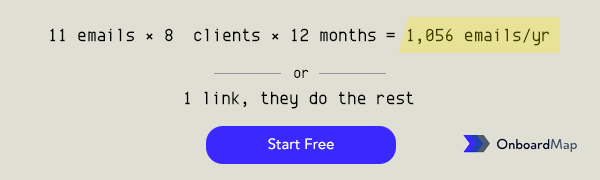
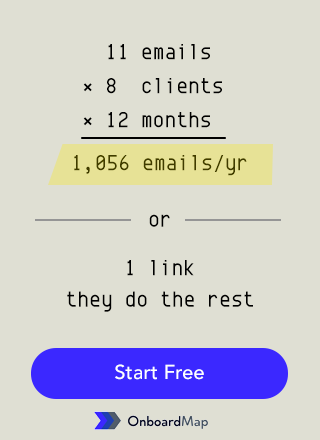
TLDR: Most agency-client relationships start dying in the first two weeks — not from bad work, but from disorganized onboarding. Stop chasing logins, brand assets, and approvals over email. Use a structured intake form, a centralized portal, and automated follow-ups to collect everything you need before the kickoff call.
You signed a new client. The contract is in. Everyone’s excited.
Then the first two weeks happen. You’re chasing logins, waiting on brand guidelines, and sending your fifth email asking for headshots. The client starts wondering if they made the right call.
This is where most agency-client relationships quietly start to die. Not from bad work. From bad onboarding.
Here’s how to fix it.
Why Agency Onboarding Is Uniquely Hard
Marketing agencies deal with a brutal combination of onboarding challenges that other service businesses don’t face:
- High volume of assets needed — logos, fonts, brand guidelines, photography, social logins, ad account access, analytics credentials
- Multiple stakeholders — the person who signed the contract is rarely the person who has the Google Analytics password
- Vague scope — “we want to grow” is not a creative brief, but it’s what you’ll get without a structured intake process
- Fast expectations — clients expect visible progress within weeks, not months
If your onboarding process is a loose collection of emails and Slack messages, you’re going to drop something. Every time.
The Agency Onboarding Playbook
Step 1: Send a Structured Intake Form (Before the Kickoff Call)
Don’t wait for the kickoff meeting to start gathering information. Send a detailed intake form within 24 hours of signing.
Your intake form should cover:
- Business basics — industry, target audience, competitors, revenue goals
- Brand assets — logo files (vector and raster), brand colors (hex codes), fonts, tone-of-voice guidelines
- Account access — Google Analytics, Google Ads, Meta Business Suite, CMS login, email platform
- Existing content — past campaigns, top-performing posts, any content they want to keep or kill
- Decision-making — who approves creative? Who approves copy? What’s the review turnaround expectation?
The goal is to walk into the kickoff call already informed.
Step 2: Collect Everything in One Place
Stop accepting assets over email. A zip file named “logos_final_v3_USE_THIS_ONE.zip” is not a system.
Use a dedicated client portal where clients can upload files, fill out forms, and see exactly what’s still outstanding. When clients can see their own progress, they stop waiting for your reminder emails.
If you want that portal to be branded with your agency’s look, check out how to set up a branded client portal.
Step 3: Run a Kickoff Call With a Real Agenda
Your kickoff call should not be a “get to know you” session. You already did that during sales. This is an alignment meeting.
Cover these items:
- Confirm goals and KPIs — specific numbers, not vibes
- Review the intake form together — fill in gaps, clarify answers
- Walk through the timeline — deliverables, milestones, review cycles
- Set communication norms — where do we talk? How fast do we respond? Who’s the day-to-day contact?
- Assign outstanding items — anything the client still owes you gets a deadline, right there on the call
Record the call. Send a summary within 24 hours.
Step 4: Send a Welcome Packet
After the kickoff, send a short welcome document that includes:
- Your team — who’s working on their account, with names and roles
- The timeline — what happens in weeks 1, 2, 4, and 8
- How to reach you — preferred channels, response time expectations
- What you need from them — a clear, prioritized list of outstanding items
This isn’t about looking polished. It’s about reducing the “what happens next?” anxiety that kills client confidence.
Step 5: Automate the Follow-Up
The number one onboarding failure at agencies is letting things sit. The client owes you ad account access. You sent one email. They forgot. Two weeks pass. Now you’re behind schedule and it feels like your fault.
Build automated reminders into your process. If a client hasn’t uploaded their brand guidelines by day 3, they get a nudge. If ad account access isn’t granted by day 5, another nudge. No manual effort required.
The Onboarding Checklist Every Agency Needs
Here’s the bare minimum for a repeatable agency onboarding process:
If you need a broader framework, the client onboarding checklist for service businesses covers the fundamentals that apply across industries.
What Good Agency Onboarding Actually Looks Like
The client fills out one form. They upload their assets to one place. They get one welcome document. They know exactly what’s happening and what they owe you.
No chasing. No confusion. No “sorry, can you resend that?”
That’s the difference between an agency that retains clients for years and one that churns through them every quarter.
Start Building Your Playbook
OnboardMap gives marketing agencies a single place to collect client information, gather brand assets, and automate follow-ups — so you can stop chasing and start delivering.
Get early access and build your agency onboarding playbook today.